
By Dr Pranab Gyawali, Consultant Gastroenterologist
UK-trained gastroenterologist in Dubai. Many of my patients with Crohn’s disease, ulcerative colitis, IBS and chronic gut symptoms have already tried one or more probiotic products. Pharmacies in Dubai and across the UAE are full of probiotic options, and the messaging online can be confusing.
A major review published in Gut in 2025 puts the probiotic story into perspective. It explains why standard probiotics have limited benefits in IBD, why diet remains central, and why the next generation of microbiome therapies may be very different from what we currently buy in pharmacies.
You can view the Gut review here: Gut review on probiotics, microbiome therapies and IBD.
Video: Probiotics, Crohn’s, Ulcerative Colitis and the Future of Microbiome Therapy
Do probiotics help ulcerative colitis or Crohn’s disease?
Short answer: sometimes in ulcerative colitis, rarely in Crohn’s disease.
In ulcerative colitis, certain probiotics, including E. coli Nissle, have shown benefit in maintaining remission for some patients. This does not mean every probiotic works, and it does not mean probiotics replace standard treatment.
In Crohn’s disease, standard probiotics have generally not shown consistent benefit in inducing or maintaining remission. Many over-the-counter probiotics simply pass through the gut without meaningfully changing the inflammation driving Crohn’s disease.
This is why I always explain to patients that probiotics have a limited, disease-specific role. They may help some patients with ulcerative colitis, but they are not a cure for IBD.
Why do standard probiotics often fail in IBD, especially Crohn’s?
Most commercial probiotics were never designed as IBD treatments. They are often based on bacteria that may be safe, but do not necessarily perform the specific functions needed to calm intestinal inflammation.
- They may not stay in the gut long enough to matter.
- They may not interact strongly with the mucus barrier or immune system.
- They may not correct the deeper dysbiosis seen in Crohn’s disease.
- They may have different effects depending on diet, medications and existing microbiome patterns.
That is why two patients can take the same probiotic and have completely different results.
What are next-generation probiotics or live biotherapeutic products?
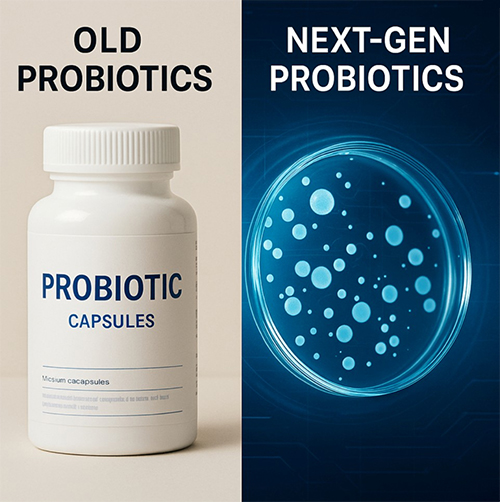
This is where the science becomes more interesting. Next-generation probiotics, also called live biotherapeutic products, are very different from typical probiotic capsules sold in pharmacies.
Most standard probiotics are not designed to stay in the gut or deliver a specific therapeutic function. Live biotherapeutic products are being developed to do something more targeted, such as supporting the mucus barrier, producing anti-inflammatory signals, changing the microbiome environment, or helping the gut lining recover.
The 2025 Gut review highlighted several examples that show where the field is heading.
MH002: a six-strain bacterial consortium studied in ulcerative colitis
MH002 is an optimised live biotherapeutic product made from six non-pathogenic, well-characterised commensal bacterial strains. It has been studied in mild-to-moderate ulcerative colitis, with early data suggesting improvement in clinical activity and reduction in faecal calprotectin.
This is important because it moves beyond the idea of a simple “probiotic supplement”. MH002 is being developed as a defined microbial therapy, not as a general wellness product.
VE-202: a 16-strain Clostridia consortium
VE-202 is another example of a defined bacterial consortium. It contains 16 Clostridia strains and has been studied as a live biotherapeutic product for inflammatory bowel disease.
Early work showed that these bacteria could colonise the gut, but the important caution is that the later phase 2 ulcerative colitis study did not meet its primary efficacy endpoint. This is a useful reminder that colonising the gut is not the same as proving clinical benefit.
Engineered Lactococcus lactis: bacteria as a delivery system
Another approach is to engineer bacteria so they deliver therapeutic molecules directly in the gut. One example is modified Lactococcus lactis, which has been studied as a way of delivering anti-inflammatory signals such as IL-10. IL-10 is an immune-calming cytokine, and trefoil factors are involved in gut lining repair and protection.
The goal is not simply to “add bacteria”, but to use bacteria as a local delivery system for molecules that may calm inflammation and support mucosal healing. This remains early-stage research and is not an approved routine treatment for Crohn’s disease or ulcerative colitis.
Akkermansia and Faecalibacterium: naturally important gut bacteria
You may also hear about single next-generation strains such as Akkermansia muciniphila and Faecalibacterium prausnitzii. These are naturally present in the human gut and are not commercial brand names. They are interesting because they perform specialised functions.
Akkermansia muciniphila is linked with the mucus layer and gut-barrier support. Faecalibacterium prausnitzii is known for producing butyrate, a short-chain fatty acid associated with anti-inflammatory effects in the gut.
But there is an important word of caution. These bacteria are highly host-dependent. Their effect depends on the patient’s existing microbiome, diet, inflammation, medications and gut environment. This is why one person may respond differently from another.
So the future of probiotics in IBD is not simply “stronger probiotics”. It is moving towards targeted, function-specific microbiome therapies. Promising, but still under investigation.
Should I take probiotics during a flare?
This depends on the condition, the severity of the flare and the treatment plan.
In ulcerative colitis, certain probiotics may support mild disease or maintenance of remission in selected patients. However, they should not replace treatment during a significant flare.
In Crohn’s disease, the evidence for standard probiotics during flares is weak. In that situation, controlling inflammation properly is the priority.
If you are flaring, probiotics should be considered supportive at most. They should not delay proper IBD assessment or escalation of therapy when needed.
What probiotic do you recommend for Crohn’s and ulcerative colitis in Dubai?
My approach for IBD patients in Dubai is always assessment first, and diet before probiotics.
1. Start with diet
I usually begin with a Mediterranean-style, whole-food, largely plant-based diet. This is often more important than choosing a probiotic brand. Diet can influence microbiome diversity, inflammation, bowel function and long-term gut health.
2. Understand disease activity
Before recommending a probiotic, I want to understand where the disease is now. That means looking at symptoms, faecal calprotectin, blood markers, medication history and whether the patient is in remission, mild activity or a flare.
3. Use probiotics selectively
For ulcerative colitis, certain strains may have a role in selected patients. For Crohn’s disease, I rarely rely on standard probiotics because the evidence remains limited.
4. Consider microbiome testing in selected patients
For patients who want more personalised dietary intervention, gut microbiome testing can sometimes help show what the gut is actually doing, which beneficial species may be reduced, and whether inflammatory patterns are present. This can help guide a more tailored nutritional strategy.
The key message is simple: do not buy probiotics based only on marketing. First understand the disease, the diet, the inflammation and the microbiome context.
Frequently Asked Questions
Do probiotics cure Crohn’s or ulcerative colitis?
No. Probiotics may support gut health in selected patients, but they do not replace proven IBD therapies such as 5-ASA medicines, immunomodulators, biologics or small molecules when these are needed.
Are next-generation probiotics available in Dubai now?
Most next-generation probiotics and live biotherapeutic products for IBD remain in clinical trials. They are promising, but they are not yet routine approved treatments for Crohn’s disease or ulcerative colitis.
What examples of next-generation probiotics are being studied in IBD?
Examples include MH002, a six-strain bacterial consortium studied in ulcerative colitis; VE-202, a 16-strain Clostridia consortium; and engineered Lactococcus lactis designed to deliver immune-calming signals such as IL-10. These are investigational therapies and are not approved routine treatments.
What matters more than the probiotic brand?
Your baseline microbiome, diet quality, inflammation level, medication history and whether you have Crohn’s disease or ulcerative colitis matter more than the brand name on the bottle.
Recommended Guides
Fecal Microbiota Transplant and Microbiome Transfer
- Are probiotics automatically good for gut health?
- MH002 next generation probiotic for ulcerative colitis
- Fecal Microbiota Transplant (FMT) for Crohn’s Disease & Ulcerative Colitis
- FMT, Infliximab and the Microbiome in IBD
Next-Generation Probiotics and Live Biotherapeutics
- Engineered Probiotic for Ulcerative Colitis 2026
- E. coli Nissle 1917: The 100-Year-Old Probiotic Still Used in Ulcerative Colitis
- Probiotics in Ulcerative Colitis: What Does the MB310 Trial Mean?
- Probiotics for Ulcerative Colitis: What Actually Works?
Gut Microbiome, Diet and IBD
- Gut Microbiome in Crohn’s Disease & Ulcerative Colitis
- Gut Microbiome Test in Dubai
- Diet, Microbiome & IBD: How the Right Bacteria Calm Gut Inflammation
- How the Oxygen Trap May Be Driving Your IBD — And Why Diet Still Matters
- What Can I Eat If I Have IBD?
- Ultra-Processed Foods and Gut Microbiome Health
- 4 Science-Backed Tips to Support Your Gut Barrier If You Have Crohn’s or UC
Core Crohn’s and Ulcerative Colitis Care
- AI in Crohn’s and Ulcerative Colitis: Can Machine Learning Predict IBD Treatment Response?
- Crohn’s Disease Specialist Care in Dubai
- Ulcerative Colitis Specialist Care in Dubai
- Learn about Biologicals used in UC and Crohn’s in Dubai
- How 5-ASA Works in Ulcerative Colitis: Salofalk, Pentasa and Asacol
- IBD Flare Risk, Diet and Calprotectin
IBD Complications and Overlooked Issues
- SIBO in Crohn’s & UC — The Overlooked Gut Issue You Shouldn’t Ignore
- Iron Deficiency & Anaemia in Crohn’s & Ulcerative Colitis
- B12 and Folate Deficiency in Crohn’s and Ulcerative Colitis
- Stress and Crohn’s & Colitis — Why the Gut–Brain Connection Matters
If you wish to discuss this further or would like to make an appointment, please use the booking form on this page. A member of our team will contact you within 12 business hours.