
By Dr Pranab Gyawali, Consultant Gastroenterologist
As doctors, we talk endlessly about inflammation, colonoscopy results, and medication plans — but we still don’t talk enough about diet. For most of my patients with Crohn’s disease or ulcerative colitis, the first and most pressing question is: “Doctor, what can I actually eat?”
I’ll be honest — even after decades of practice in London and now here in Dubai, I sometimes run out of time in clinic to explore it properly. But I always try, because food choices can make a real difference to comfort, confidence, and disease control.
Is there a specific “IBD diet” everyone should follow?
No. There is no single plan that suits all IBD patients. The right approach depends on whether you are in a flare or remission, where the disease is located (small bowel vs colon), whether strictures are present, and your individual tolerance. Keeping a food–symptom diary is invaluable.
What should I eat during a flare?
When the bowel lining is inflamed and sensitive, a short-term low-residue approach can help reduce stool volume and mechanical irritation. Practical options include white rice, ripe bananas, eggs, yogurt. Avoid raw salads, whole nuts, seeds, and very fibrous vegetables until things settle.
How does small-bowel Crohn’s change diet choices?
If the small intestine — especially the terminal ileum — is affected or has been resected, fat absorption can be reduced. Many patients find fried or greasy foods aggravate diarrhea. Moderate amounts of healthy fats (e.g., olive oil) are typically better tolerated.
Which foods commonly worsen ulcerative colitis symptoms?
Many UC patients report discomfort with spicy meals, alcohol, and some artificial sweeteners such as sorbitol. Responses vary; use supervised elimination and careful reintroduction.
What diet supports remission?
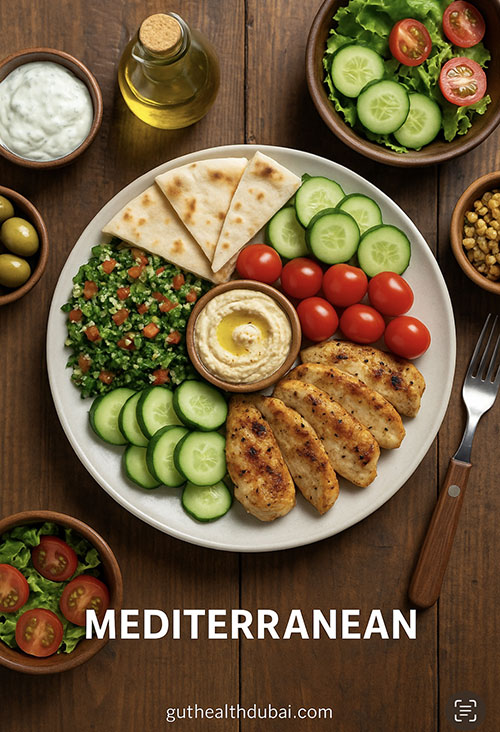
When inflammation is under control, shift towards a Mediterranean-style diet — olive oil, fish, whole grains, fruits, vegetables. This pattern is linked with more favourable gut microbiome profiles and may lower relapse risk. If strictures are present, adjust texture and fibre (e.g., peel, cook well, or blend).
Interested in testing? See our gut microbiome test in Dubai.
Final advice
Diet matters — but it’s personal. Work with an IBD dietitian and your gastroenterologist to tailor a plan. If you’re in Dubai and need guidance, get in touch.
Disclaimer: Educational information only. Always seek personalised medical advice. The Mediterranean approach suits many IBD patients but may need modification if strictures or significant disease activity are present.
Recommended Guides:
FMT, Probiotics and Next-Generation Microbiome Therapies
- AI in Crohn’s and Ulcerative Colitis: Can Machine Learning Predict IBD Treatment Response?
- FMT and infliximab in IBD: could the microbiome help biologics work better?
- Fecal microbiota transplant for Crohn’s disease and ulcerative colitis
- Probiotics for Crohn’s and ulcerative colitis: what actually works?
- Probiotics in ulcerative colitis: what does the MB310 trial mean?
- Engineered probiotic for ulcerative colitis 2026
- Probiotics for ulcerative colitis: what actually works?
Gut Microbiome, Diet and Treatment Response
- Diet and microbiome in IBD: how the right bacteria calm gut inflammation
- Gut microbiome in Crohn’s disease and ulcerative colitis
- How the Oxygen Trap may be driving your IBD, and why diet still matters
- IBD flare risk, diet and calprotectin
- IBD breakthrough: how gut bacteria unlock natural anti-inflammatories
- Gut microbiome test in Dubai
Crohn’s, Colitis and Biologic Treatment Strategy
- Learn about Biologicals used in UC and Crohn’s in Dubai
- Crohn’s disease specialist care in Dubai
- Ulcerative colitis specialist care in Dubai
- How biologics work in Crohn’s and colitis
- How we choose the right biologic for Crohn’s and UC in Dubai
- New omics research: predicting response to biologics in Crohn’s and ulcerative colitis
Investigations and Procedures
- Colonoscopy for Crohn’s and ulcerative colitis monitoring
- Capsule endoscopy for small bowel Crohn’s disease
- MRI abdomen and MR enterography
- CT abdomen and CT enterography
- Hydrogen and methane breath test for SIBO
If you wish to discuss this further or would like to make an appointment, please use the booking form on this page.