
What is new?
This page was first published in November 2025. It now includes a new video and longer-term safety results from six IBD trials. The original patient guide remains below.
Is Rinvoq safe long term?
The new longer-term analysis is reassuring because it did not find an unexpected safety problem. Rinvoq is not risk free. Shingles, acne and changes in blood or liver tests remain important. Blood clots, serious heart problems and cancers were uncommon in the trials, but rare risks cannot be ruled out. The dose and each person's health risks still matter.
I first made this page to explain what Rinvoq is, how it works and who it may help. I have now updated it because patients also want to know what we have learned about longer use.
I am a consultant gastroenterologist, MBBS (London), FRCP (UK), with more than 25 years of clinical experience. My role is to put the study numbers into the context of the person considering treatment.
What is Rinvoq and how does it work?
Rinvoq is the trade name for upadacitinib. It is a once-daily tablet from a group of medicines called JAK inhibitors.
It blocks signals inside immune cells that help drive inflammation. Unlike a biologic medicine, it is not given by injection or infusion, and the body does not make antidrug antibodies against it.
How effective is Rinvoq for Crohn's disease and ulcerative colitis?
Rinvoq can work quickly for some people, but it does not work for everyone. In the main trials, about one in three people with ulcerative colitis were in remission after eight weeks. In Crohn's disease, about four in ten were in remission after 12 weeks. Among people who improved and continued treatment, about four to five in ten were in remission at one year.
These are averages from groups of patients. They cannot predict exactly what will happen to one person. We also check inflammation with tests such as calprotectin, blood tests, endoscopy or scans. Feeling better is important, but it does not always mean the bowel has healed.
Who might Rinvoq suit?
Rinvoq may be considered when moderate to severe IBD has not responded adequately to conventional treatment or another advanced medicine. Some patients value a once-daily tablet and the possibility of a relatively rapid response.
It is not suitable for everyone. Pregnancy plans, active or recurrent infection, shingles history, age, smoking, cardiovascular disease, previous blood clots and cancer risk all matter. The decision is a balance between the risk of uncontrolled IBD and the risks of treatment.
What should you discuss before starting Rinvoq?
- Is Rinvoq suitable for the type and severity of my IBD?
- How would I move safely from my current treatment?
- Do infection, shingles, pregnancy, heart, clotting or cancer risks change the choice?
- How will we check whether it is controlling inflammation, not only symptoms?
These questions keep the decision focused on both benefit and safety.
What does the new long-term safety update tell us?
Researchers combined results from three ulcerative colitis trials and three Crohn's disease trials. During maintenance and longer follow-up, 1,910 people received Rinvoq. Together, they contributed just over 5,000 patient years of treatment.
A patient year simply adds everyone's follow-up together. For example, 100 people treated for one year provide 100 patient years. It does not mean that every person took Rinvoq for several years.
The median treatment time, meaning the middle of the group, was about one year with 15 mg and about two and a half years with 30 mg. Some people were followed for longer.
Which side effects need attention?
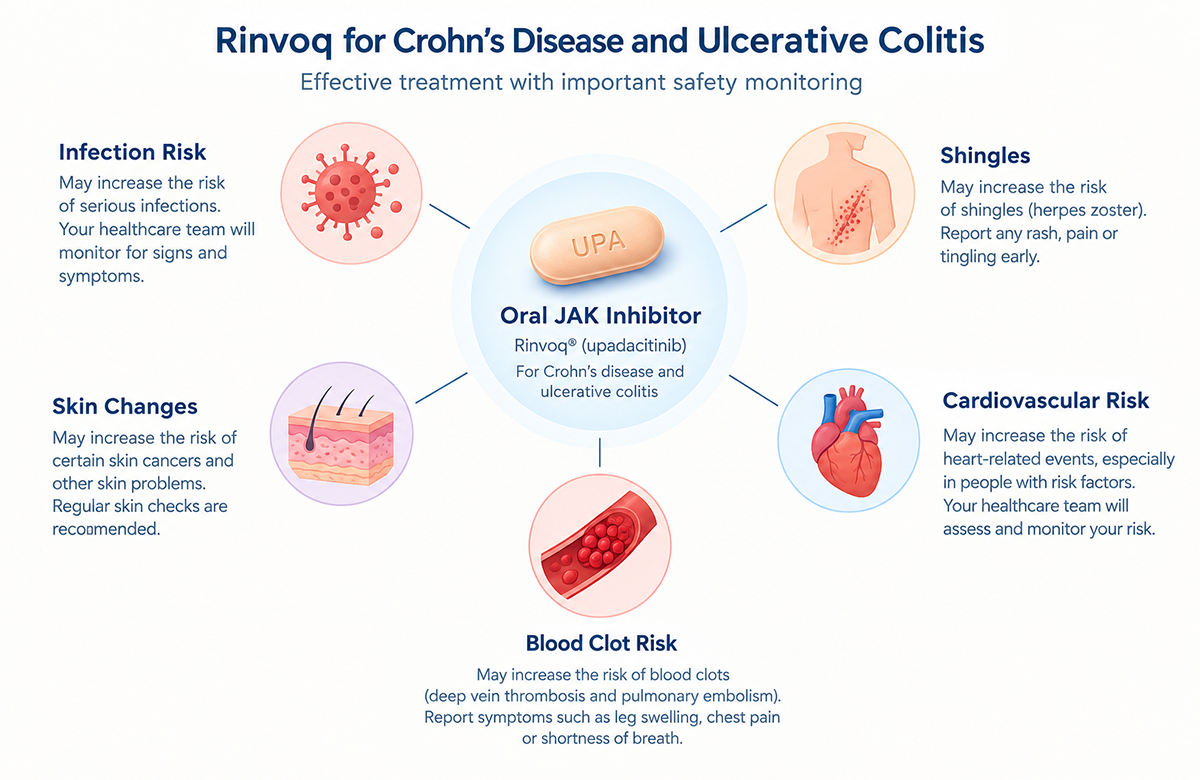
Shingles occurred more often with Rinvoq than with placebo. Blood-cell counts, liver tests and a muscle enzyme measured in blood could also change, which is why monitoring is needed.
Acne was usually mild and rarely made people stop treatment in the trials. It can still be troublesome, particularly for younger patients.
The 45 mg dose is used at the start of treatment. Maintenance is usually 15 mg or 30 mg. Side effects can be dose related, so the maintenance dose should balance disease control with the person's risks.
What did the analysis show about blood clots, heart events and cancer?
Blood clots in the veins were uncommon. The rates were about 0.3 events for every 100 patient years with 15 mg and 0.4 with 30 mg. Most occurred in people who already had other risk factors.
There were no major heart or circulation events with 15 mg during maintenance and longer follow-up, and two with 30 mg. Cancers were also uncommon.
These small numbers are reassuring, but they cannot prove that the risks are zero. Age, smoking and a person's history of heart disease, blood clots or cancer remain important. JAK inhibitors also carry regulator safety warnings.
| Finding | What it means | What it does not mean |
|---|---|---|
| More than 5,000 patient years | A useful amount of combined follow-up | Every patient was treated for years |
| Uncommon clot, heart and cancer events | No unexpected safety pattern appeared | These risks are zero |
| More shingles and some blood-test changes | Prevention and monitoring still matter | Everyone will develop them |
| Results for 15 mg and 30 mg | Dose is part of the safety discussion | One dose is right for everyone |
How do dose and individual risk factors change the decision?
Age, smoking, previous blood clots, heart disease, cancer history, repeated infections and shingles history can change the balance. Active IBD itself also increases blood-clot risk, especially during a severe flare or hospital admission. The right choice can therefore be different for two people with the same diagnosis.
What screening, vaccination and monitoring matter?
Before treatment, the clinical team checks for infections such as tuberculosis and hepatitis. They also review vaccinations, pregnancy plans, blood tests and personal heart or clotting risks. Shingles vaccination may be appropriate.
During treatment, blood counts, liver tests and cholesterol are checked, alongside the response of the IBD. Seek prompt medical advice for a painful blistering rash, chest pain, sudden breathlessness, one-sided leg swelling or a severe infection.
What are the study limitations?
Researchers combined information from completed trials rather than starting a new long-term trial. Trial participants are carefully selected and monitored, so the results may not represent every patient seen in routine practice.
There was also no long-term placebo group for a simple comparison. Very rare events remain difficult to measure, even with more than 5,000 patient years of follow-up. The trials were sponsored by the manufacturer, which should be considered when interpreting the findings.
My clinical view
The accumulated exposure and absence of a new pattern are reassuring. I would not describe Rinvoq as risk free, and I would not make the decision from the headline alone.
I look at IBD severity, what has failed, how quickly control is needed, the maintenance dose and the patient's infection, cardiovascular, clotting and cancer risks. For the right person, Rinvoq can be an effective long-term treatment. The safety conversation should be specific and revisited when health or risk factors change.
Would you like more evidence-based IBD updates?
Choose Gut Health Dubai as a Preferred Source on Google so future Crohn's disease, ulcerative colitis and treatment updates are easier to find.
Frequently asked questions
Is Rinvoq safe to take for several years?
The analysis provides useful longer-term reassurance and found no new safety signal. It cannot prove zero risk, and follow-up varied considerably.
Does Rinvoq increase cancer, heart attack or blood-clot risk?
These events were uncommon in the IBD trials, but numbers were small and JAK inhibitors carry important warnings. Personal risks need review.
How common are shingles and acne with Rinvoq?
Shingles occurred more often with upadacitinib than placebo. Acne was recognised and usually mild in the trials, though real-world studies may report it more often.
Is 15 mg safer than 30 mg for maintenance treatment?
Some adverse events are dose related, but dose choice also depends on disease control and individual risk. The prescribing team should make that decision.
Research source
Panaccione et al. Long-term safety of upadacitinib in IBD. DOI 10.1016/j.cgh.2026.02.018
This page is for general education and does not replace individual medical advice. Do not stop, reduce or change Rinvoq without speaking to the prescribing gastroenterologist or IBD team.
Recommended related reading
If you would like to discuss whether an advanced IBD treatment fits your circumstances, you can use the appointment form below.