
2026 Update from a UK-trained gastroenterologist in Dubai.
In this short video, I discuss new research looking at fecal microbiota transplantation, or FMT, in inflammatory bowel disease, including Crohn’s disease and ulcerative colitis.
The reason this study caught my attention is that it looked not only at FMT alone, but also at a small group of difficult Crohn’s disease patients where FMT was combined with infliximab, one of the best known biologic treatments in IBD.
This is still early research. FMT is not routine treatment for Crohn’s disease or ulcerative colitis outside clinical trials. But the study is interesting because it highlights something important: the gut microbiome may influence inflammation and may also affect how some patients respond to biologics. Original study here.
What is FMT?
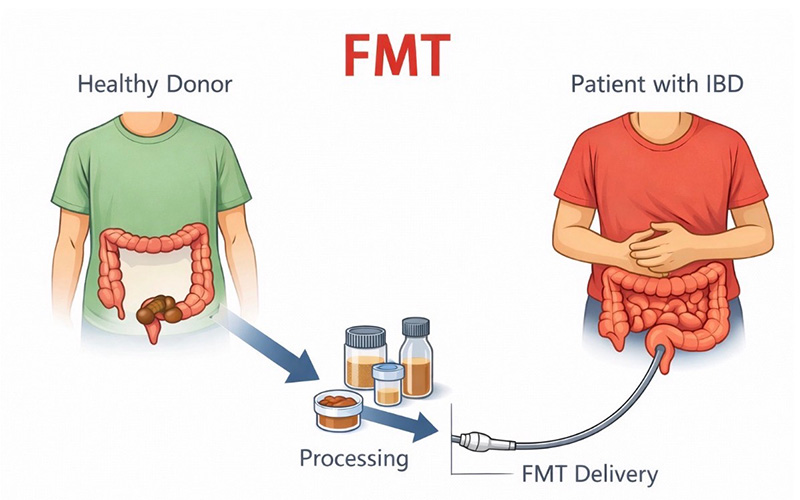
FMT stands for fecal microbiota transplantation.
In simple terms, stool bacteria from a carefully screened healthy donor are processed and transferred into the gut of a patient. The aim is to shift the gut microbiome from a disturbed inflammatory pattern toward a healthier microbial ecosystem.
This is very different from a standard probiotic. A probiotic usually contains a small number of selected bacteria. FMT is much broader. It is closer to transferring a whole microbial ecosystem.
Why is the microbiome important in IBD?
Crohn’s disease and ulcerative colitis are not driven by one single pathway.
We often talk about immune pathways such as TNF, IL 23, JAK signalling and other inflammatory signals. But the gut microbiome is also part of the picture.
The difficult part is that we still do not fully understand the microbiome. Many gut bacteria are still poorly characterised, and in many cases we do not know exactly what they do.
That is why FMT studies in IBD have produced mixed results so far. The field is promising, but it is also complex.
What did this FMT study look at?
This study included 37 patients with Crohn’s disease and ulcerative colitis.
Some patients received FMT alone. The most interesting group for me was a small group of refractory Crohn’s disease patients who received infliximab plus FMT.
| Group | Treatment approach | Reported result |
|---|---|---|
| Ulcerative colitis | FMT alone | 12 patients responded by week 4 |
| Crohn’s disease | FMT alone | 9 biologic-naïve patients responded by week 4 |
| Refractory Crohn’s disease | Infliximab plus FMT | 6 of 9 responded by week 4 |
The most important point is not that FMT is now proven treatment. It is not. The important point is that the study suggests the microbiome may be a relevant pathway, especially in patients who are difficult to treat.
What happened in the infliximab plus FMT group?
This is the part I focused on in the video.
There were 9 refractory Crohn’s disease patients treated with infliximab plus FMT.
| Result | Number |
|---|---|
| Refractory Crohn’s patients treated with infliximab plus FMT | 9 |
| Responded by week 4 | 6 of 9 |
| Clinical remission by week 14 | All 6 responders |
| Endoscopic remission by week 14 | All 6 responders |
This is a small number of patients, so we must be careful. But it is still an interesting signal.
It raises the question of whether, in some biologic resistant patients, blocking the immune pathway may not be enough if the gut microbiome remains disturbed.
Did the microbiome actually change?
Yes. This is one of the more important parts of the study.
The researchers reported changes in the gut microbiome and metabolome after FMT. Responders appeared to shift toward a more donor-like microbial pattern, with changes in bacterial diversity and metabolic pathways, including bile acid and amino acid related pathways.
That means the study was not only looking at symptoms. It was also looking at whether the gut ecosystem itself had changed.
Is FMT now a treatment for Crohn’s disease or ulcerative colitis?
No.
FMT is not currently standard care for Crohn’s disease or ulcerative colitis outside clinical trials.
That needs to be clear. This study was small, and the infliximab plus FMT group was especially small. It cannot prove that this combination should now be used routinely.
But it does provide a signal that deserves proper testing. The authors are planning larger randomized controlled trials, which is exactly what this field needs.
How is FMT different from next-generation probiotics?
Next-generation probiotics are more controlled. They usually involve selected bacteria or defined bacterial communities.
FMT is broader and less precise. It transfers a complex microbial ecosystem from a donor.
That is why FMT may have powerful effects, but also why it is harder to standardize and study.
Both approaches are trying to answer the same bigger question: can changing the gut microbiome improve IBD outcomes, especially when combined with biologic treatment?
My view
My view is that the microbiome is one of the most important but least understood pathways in inflammatory bowel disease.
We have not cracked it yet.
FMT should not be presented as routine treatment for Crohn’s disease or ulcerative colitis.
But this study is worth watching because it gives an interesting signal in a clinically important group: difficult Crohn’s disease patients treated with infliximab plus FMT.
If larger trials confirm this, the future of IBD treatment may not only be about choosing the right biologic.
It may also be about understanding the gut microbiome environment that biologic is working inside.
Key takeaways
| Question | Simple answer |
|---|---|
| Is FMT proven routine treatment for IBD? | No |
| Was this study interesting? | Yes |
| Why? | It looked at FMT alone and FMT with infliximab |
| Key refractory Crohn’s result | 6 of 9 responded by week 4 |
| Week 14 result | All 6 responders achieved clinical and endoscopic remission |
| Main limitation | Small study |
| What is needed next? | Larger randomized controlled trials |
Frequently asked questions
What is FMT in IBD?
FMT means fecal microbiota transplantation. It is a microbiome-based treatment approach where processed gut bacteria from a carefully screened donor are transferred into a patient’s gut.
Can FMT treat Crohn’s disease?
FMT is being studied in Crohn’s disease, but it is not currently routine treatment. This study showed an interesting signal in refractory Crohn’s disease patients treated with infliximab plus FMT, but larger trials are needed.
Can FMT treat ulcerative colitis?
FMT has been studied in ulcerative colitis, and some studies have shown positive signals. However, it remains an area for clinical trials rather than routine care.
What is the link between FMT and infliximab?
Infliximab targets the immune pathway by blocking TNF. FMT targets the gut microbiome. This study explored whether combining immune pathway treatment with microbiome treatment may help some difficult IBD patients.
Is FMT the same as probiotics?
No. Probiotics usually contain selected bacteria. FMT is much broader and transfers a complex microbial ecosystem from a donor.
Should patients seek FMT for Crohn’s or ulcerative colitis?
Patients should not seek FMT casually or outside specialist governance. At present, FMT for IBD should mainly be considered within clinical trials or specialist research settings.
Recommended Guides for Biologics, Crohn’s and Colitis
Understanding IBD
- AI in Crohn’s and Ulcerative Colitis: Can Machine Learning Predict IBD Treatment Response?
- MH002 and next generation microbiome therapy in ulcerative colitis
- Dual biological pathway blocking in Crohn’s and colitis
- Crohn’s Disease – Symptoms, Tests & Treatment in Dubai
- Ulcerative Colitis – Symptoms, Tests & Treatment in Dubai
- How Biologics Work in Crohn’s & Colitis
- Crohn’s & Colitis: Why You Shouldn’t Stay on Steroids
- Is Your Gut Really Healed? Understanding Deep Remission
- Ulcerative Colitis Progression in Dubai
- Rectal Bleeding
- SIBO in Crohn’s & Ulcerative Colitis
IBD-Focused VLOGs & Patient Education
- Diet, calprotectin and flare prediction in Crohn’s and ulcerative colitis
- Is Your Gut Microbiome Behind Crohn’s Disease Flares?
- Diet, Microbiome & IBD
- Predicting Biologic Treatment Success in Crohn’s & UC
- IBD Treatment Updates & What’s Changing
- Rinvoq for Crohn’s & Ulcerative Colitis
- Tremfya (Guselkumab) Explained
- Stress and the Gut–Brain Axis in IBD
Nutrition & IBD
- Should you avoid dairy in Crohn’s and ulcerative colitis?
- What Can I Eat If I Have IBD?
- Coffee and Bread in Crohn’s & Ulcerative Colitis
- Ultra-Processed Foods and Gut Inflammation
- Vitamin D and Gut Health in IBD
- Iron-Rich Foods for Anaemia in Crohn’s & Colitis
- B12 and Folate Deficiency in IBD
Cross-Condition & Related Topics
Investigations & Procedures Used in IBD Care
- Colonoscopy
- Capsule Endoscopy
- Hydrogen & Methane Breath Test
- Gut Microbiome Testing
- MRI / CT Enterography
If you wish to discuss this further or would like to make an appointment, please use the booking form on this page. A member of our team will contact you within 12 business hours.