
Does FMT work for Crohn’s disease or ulcerative colitis?
FMT has shown a stronger treatment signal in ulcerative colitis than in Crohn’s disease, but it is not routine treatment for either condition. A new randomised Crohn’s trial had mixed overall results. It found a significantly greater endoscopic response with FMT, while clinical response varied considerably according to the stool donor. The problem may not be that the microbiome cannot be treated. The problem may be that we have not yet learned how to treat it precisely.
Patients I see with Crohn’s disease and ulcerative colitis regularly ask me whether faecal microbiota transplantation could help them. I have always answered cautiously. Ulcerative colitis has produced the clearer signal, while Crohn’s studies have been less consistent.
I made this VLOG because a new Crohn’s trial contains two findings worth looking at: the endoscopic response and the large variation between stool donors. Neither makes FMT a routine Crohn’s treatment, but both help us ask a more precise research question.
New Crohn’s FMT trial: two signals worth noticing
What is FMT?
Fecal microbiota transplantation, or FMT, transfers specially processed stool from a carefully screened donor into another person’s digestive tract. The aim is to alter the recipient’s gut microbiome.
It is not the same as taking an ordinary probiotic. A probiotic usually contains a small number of selected strains. FMT transfers a much broader and less standardised microbial ecosystem.
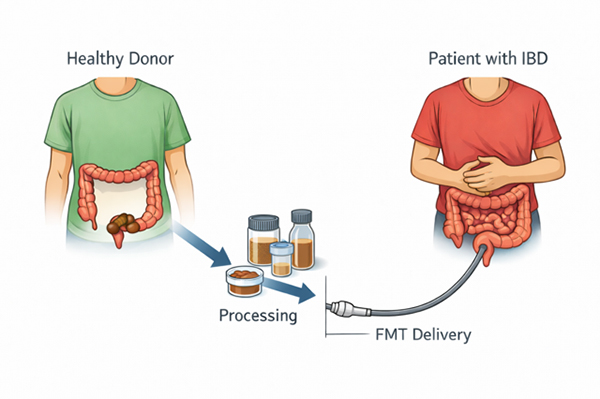
Is the evidence stronger in ulcerative colitis?
Yes. Randomised trials and meta-analyses have found a more consistent short-term remission signal in active ulcerative colitis than in Crohn’s disease. But outcomes still vary between studies, and questions remain about donor selection, dose, delivery route, treatment frequency, preparation and durability.
That is why FMT remains investigational for ulcerative colitis rather than a predictable, standardised treatment. Current guidance does not recommend routine FMT for IBD outside clinical trials or appropriately governed specialist research settings.
What did the new Crohn’s trial add?
The MIRO randomised, double-blind, placebo-controlled trial involved 103 people with active Crohn’s disease: 70 received FMT and 33 received placebo.
The main clinical comparison was not statistically significant. But endoscopic response occurred in 53% with FMT compared with 24% with placebo. Clinical response across five donors ranged from 43% to 93%.
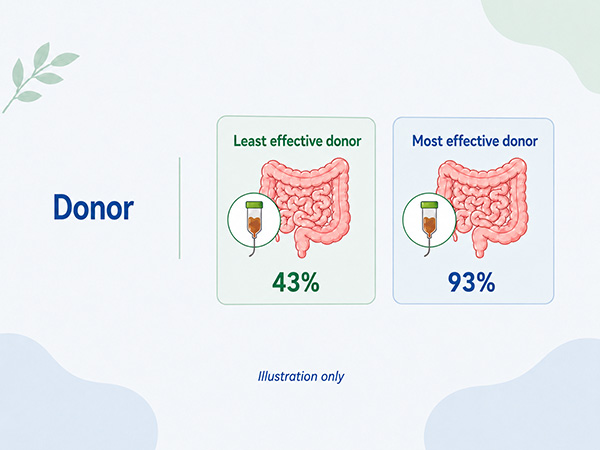
Why might the donor make such a difference?
We need to stop thinking of FMT as one single treatment.
With a conventional medicine, every dose should contain the same defined ingredients. But every FMT preparation is different. Each donor provides a different mixture of bacteria, viruses, metabolites and microbial functions.
That variability may be both the promise and the problem. It may explain why some patients appear to have remarkable responses while others gain very little.
Crohn’s disease and ulcerative colitis: how does the evidence compare?
| Ulcerative colitis | Crohn’s disease | |
|---|---|---|
| Current signal | More consistent positive signal across randomised trials | More limited and mixed evidence |
| Routine treatment? | No | No |
| Main uncertainty | Donor, protocol, dose, delivery and durability | Which donor, which patients and which microbial functions matter |
| Future direction | More standardised microbiome products | Precision donor and recipient matching |
What does this mean for patients now?
FMT should not replace established Crohn’s disease or ulcerative colitis treatment. Patients should not attempt unregulated or do-it-yourself FMT because donor screening, preparation and delivery carry important safety issues.
But the research remains worth following. The more useful question may no longer be simply, “Does FMT work?” It may be: which microbial functions, from which donor, for which patient?
Earlier FMT overview
FMT in Crohn’s disease and ulcerative colitis
This earlier overview explains why the evidence has historically been stronger in ulcerative colitis and why FMT is not routine IBD treatment.
Is the future still conventional stool transplantation?
Possibly not. Researchers are increasingly trying to identify the organisms and microbial functions associated with successful FMT and then reproduce them as defined live biotherapeutic products.
This is the bridge from variable donor material toward more precise and reproducible microbiome treatment. My related updates explain how that field is developing:
My clinical view
The ulcerative colitis signal is real but still inconsistent. The Crohn’s evidence remains less certain, but the new donor-effect finding gives us a credible reason to remain interested.
The problem may not be that the microbiome cannot be treated. The problem may be that we have not yet learned how to treat it precisely.
Would you like to see more IBD updates?
You can choose Gut Health Dubai as a Preferred Source on Google for future Crohn’s disease and ulcerative colitis articles.
Frequently asked questions
Does FMT work for ulcerative colitis?
FMT has shown a more consistent short-term remission signal in ulcerative colitis than in Crohn’s disease. But results vary, it is not sufficiently standardised, and it is not routine treatment outside trials or specialist research settings.
Does FMT work for Crohn’s disease?
The evidence remains mixed. The MIRO trial did not show a statistically significant difference in its main clinical endpoint, but it found significantly greater endoscopic response with FMT and substantial variation between donors.
Did 93% of patients achieve remission?
No. The 93% figure was a clinical-response rate associated with one donor. It was not reported as remission, endoscopic remission or mucosal healing.
Why did the stool donor matter?
Each donor contributes a different microbial ecosystem. The trial suggests that donor preparations may have very different therapeutic potency, although the donor groups were small and need further study.
Is FMT a standard treatment for IBD?
No. FMT is established for selected recurrent Clostridioides difficile infection, but it remains investigational for Crohn’s disease and ulcerative colitis.
Should patients try FMT themselves?
No. Unregulated or do-it-yourself FMT can transmit infections and other harmful organisms. FMT requires stringent donor screening and appropriately governed clinical delivery.
Research sources
- MIRO randomised placebo-controlled Crohn’s FMT trial results
- Published MIRO trial protocol
- Updated systematic review and meta-analysis of randomised FMT trials in ulcerative colitis
- AGA guideline on fecal microbiota-based therapies
This page is for education and does not replace individual medical advice. Do not change prescribed IBD treatment or pursue FMT without discussing it with your specialist team.