
By Dr Pranab Gyawali, Consultant Gastroenterologist
A newly published preclinical study has described a next generation engineered probiotic for ulcerative colitis. This is not a new biologic. It is a modified strain of E coli Nissle 1917 designed to survive in the inflamed colon.
This matters because ulcerative colitis treatment has traditionally focused on suppressing inflammation through medicines such as anti TNF therapy, IL 23 inhibitors and JAK inhibitors. This research approaches the problem differently. It asks whether we can change the environment inside the bowel itself.
Video explanation
What is the main idea?
E coli Nissle 1917 is not new. It is a probiotic strain that has been known for more than 100 years and has been studied in ulcerative colitis, especially for remission maintenance.
The new study is different because researchers engineered this strain so that it can use tetrathionate, a chemical by product of inflammation, as a fuel source.
In simple terms, a standard probiotic may struggle inside an inflamed colon. This engineered strain is designed to gain an advantage in that same inflammatory environment.
Why does this matter for patients with ulcerative colitis?
Many patients ask about probiotics, diet and microbiome treatments in ulcerative colitis. The honest answer is that traditional probiotics have often produced mixed or modest results.
However, this research represents a different category. It is not generic probiotic supplementation. It is closer to a precision designed live biotherapeutic, where the organism is modified for a specific inflammatory environment.
Visual explanation
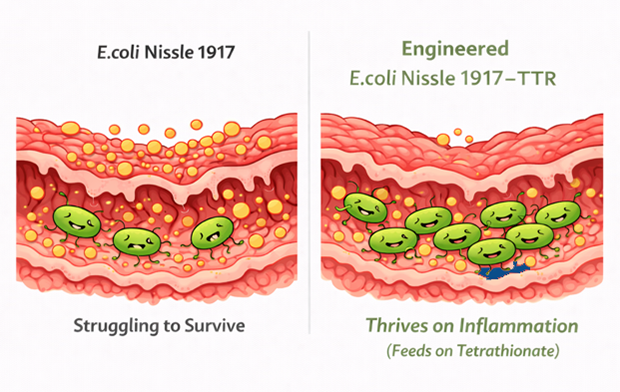
Figure: Standard E coli Nissle 1917 struggles in an inflamed colon, whereas engineered E coli Nissle 1917 TTR can thrive in inflammation by feeding on tetrathionate. This is a simplified illustration of the preclinical concept.
Quick summary of the study
| Question | Summary |
|---|---|
| What was studied? | An engineered version of E coli Nissle 1917 called E coli Nissle 1917 TTR. |
| What was it engineered to do? | Use tetrathionate, an inflammation related by product, as an energy source. |
| What condition is this aimed at? | Ulcerative colitis. |
| What type of evidence is available? | Preclinical animal data, not human efficacy data. |
| What is planned next? | Human safety testing is planned. |
What did the animal studies show?
The study reported results from animal models of colitis. These included mouse models of severe colitis and a porcine model of acute colitis.
The engineered strain showed better colonisation and stronger anti inflammatory effects than the unmodified parent strain. In the porcine model, untreated animals became severely unwell, whereas treated animals showed improved clinical and tissue findings.
| Finding | Why it matters |
|---|---|
| Better survival in inflammatory conditions | The engineered strain was designed to function in an inflamed bowel environment. |
| Improved colonisation | Colonisation is one of the major limitations of traditional probiotics in active inflammation. |
| Improved mucosal integrity | This suggests possible protection of the bowel lining in preclinical models. |
| Reduced inflammatory severity | This supports the concept that microbiome derived therapies may influence inflammatory activity. |
Important caution
This is still animal data. It is not yet proof that this treatment works in humans with ulcerative colitis.
Many therapies look promising in animal studies but do not always translate into human benefit. For that reason, the next important step is human safety testing, followed by carefully designed clinical efficacy trials.
How is this different from biologics?
Biologics and advanced therapies usually work by targeting immune pathways. Examples include anti TNF medicines, IL 23 inhibitors and JAK inhibitors.
The engineered probiotic concept is different. It does not primarily aim to block one inflammatory pathway. Instead, it attempts to modify the bowel environment in which inflammation occurs.
| Current treatment approach | Engineered microbiome approach |
|---|---|
| Blocks immune signals such as TNF or IL 23 | Modifies the inflammatory environment inside the colon |
| Works through immune pathway suppression | Works through targeted microbial metabolism |
| Established role in moderate to severe ulcerative colitis | Still experimental and preclinical |
| Used in clinical practice now | Requires human safety and efficacy trials |
Will this replace biologics?
In my view, it is unlikely that engineered probiotics will replace biologics in the near future.
The more realistic possibility is that microbiome derived therapies may eventually complement biologics. They may help stabilise the bowel environment, reduce flare tendency or support longer term disease control. That remains to be proven in human studies.
Why this is strategically important
For years, probiotics in inflammatory bowel disease have been viewed as weak or inconsistent. That criticism has often been fair, especially when discussing generic probiotics.
But the field is changing. We are moving from broad probiotic supplements toward more targeted live biotherapeutic products. These are designed with a specific biological purpose.
This is why the study is interesting. It reflects a larger shift in ulcerative colitis research, from only blocking inflammation to also thinking about the microbiome and bowel environment that shape immune behaviour.
Frequently asked questions
Is this engineered probiotic available now?
No. It is not currently available as a treatment for ulcerative colitis. The published data is preclinical.
What is tetrathionate?
Tetrathionate is a chemical by product associated with intestinal inflammation. The engineered strain is designed to use it as an energy source.
Does this mean probiotics work for ulcerative colitis?
Not all probiotics are the same. Generic probiotics and engineered live biotherapeutics should not be treated as equivalent. This study is about a specifically engineered strain, not a standard over the counter probiotic.
Could this help people already on biologics?
That is not proven yet. In the future, microbiome based therapies may be studied alongside biologics, but human clinical trials are needed first.
Why is this relevant to microbiome medicine?
It shows how microbiome science is moving from general supplementation toward targeted interventions designed for specific disease environments.
Final thought
This is early research, but it is important because it shows the direction of travel. Ulcerative colitis treatment may not only be about suppressing immune pathways. It may also involve changing the bowel environment that drives inflammation.
Recommended Guides
Ulcerative Colitis Basics & Patient Education
- Are probiotics automatically good for gut health?
- The new miR-124 treatment pathway
- MH002 live biotherapeutic product for ulcerative colitis
- Gut Microbiome in Crohn’s Disease & Ulcerative Colitis
- Predicting Biologic Treatment Success in Crohn’s & Ulcerative Colitis
- Ulcerative Colitis Progression in Dubai: What the Research Shows + 3 Ways to Reduce Risk
- Don’t Ignore Your 5-ASA — Proven Treatment for Ulcerative Colitis
- Learn about Biologicals used in UC and Crohn’s in Dubai
- Biologics and Pregnancy
- Probiotics for Ulcerative Colitis: What Actually Works?
- JFK Had Ulcerative Colitis — Why You’re Not Alone
- Can Ayurvedic Medicine Help Ulcerative Colitis?
- Predicting Vedolizumab Response Early in IBD
Ulcerative Colitis Diet, Lifestyle & Flare Control
- Ulcerative Colitis Diet: 3 Gut-Friendly Foods That Help Control Flares
- Can Coconut Oil Help with Ulcerative Colitis?
- Curcumin & Qing Dai in Ulcerative Colitis — What You Should Know
- Stress and Colitis — Why the Gut–Brain Connection Matters
Gut Microbiome, Leaky Gut & Overlooked Issues
- New Test for Diagnosing Crohn’s & Colitis: Microbiome-Based IBD Diagnosis
- Leaky Gut in IBD — What It Really Means
- IBD Breakthrough: How Gut Bacteria Unlock Natural Anti-Inflammatories
- SIBO in IBD — The Overlooked Issue You Shouldn't Ignore
Nutritional Deficiencies & Complications in IBD
Related Gastroenterology Topics
Digestive Conditions
- Gut Microbiome Test
- Irritable Bowel Syndrome (IBS)
- Crohn’s Disease
- Acid Reflux Treatment
- Gastritis
- H- Pylori Treatment
- Abdominal Pain
- Bloating
- Constipation
- Fatty Liver
- Rectal Bleeding
- Functional Dyspepsia
- Eosinophilic Esophagitis
- Food Intolerances
- Hemorrhoids
Diagnostic Tests & Procedures
- Hydrogen & Methane Breath Test (SIBO)
- Capsule Endoscopy
- Gastroscopy
- Colonoscopy
- CT Abdomen / CT Enterography
- MRI Abdomen / MR Enterography
- Urea Breath Test
- Fecal H. pylori Antigen
If you wish to discuss this further or would like to make an appointment, please use the booking form on this page. A member of our team will contact you within 12 business hours.