
Capsule endoscopy at a glance
Capsule endoscopy examines the small bowel using a camera that you swallow. No sedation is required. The recording equipment is fitted at the clinic, then you return home while the capsule sends images to a recorder worn on a belt.
Before arranging the test, Dr Pranab Gyawali reviews whether it is likely to answer the clinical question and whether it can pass safely. MR enterography is routinely used to look for a narrowing.
How the capsule endoscopy service works
- Assessment: Dr Pranab reviews the reason for the test, your previous results and your medicines.
- Small bowel safety check: MR enterography is used to assess bowel patency and look for a narrowing before the capsule is arranged.
- Capsule appointment: The belt and recorder are fitted at the clinic and you swallow the capsule with water. No sedation is required.
- Recording at home: You return home wearing the equipment. Recording usually continues for approximately 12 hours. You remove the belt when instructed and return the recorder the following day.
- Report and follow up: Dr Pranab reviews the images and arranges an appointment to explain the result, usually within the same week.
Watch: how capsule endoscopy works
The current explainer shows how the swallowable camera travels through the digestive tract, transmits images to the recorder and allows the small bowel to be examined without sedation.
Quick answers about capsule endoscopy in Dubai
What is capsule endoscopy?
Capsule endoscopy uses a camera inside a capsule that is approximately the size of a large vitamin tablet. After it is swallowed, it travels through the digestive tract and takes thousands of images. These images are transmitted to a recorder worn outside the body.
The capsule is particularly useful for examining the small bowel. Much of this part of the digestive tract lies beyond the reach of a standard gastroscopy or colonoscopy.
Why might I need capsule endoscopy?
Dr Pranab may consider the test when there is a clinical reason to examine the small bowel lining more closely. Examples include:
- suspected Crohn's disease affecting the small bowel
- unexplained iron deficiency anaemia
- suspected bleeding from the small bowel
- black stools or recurrent bleeding when earlier tests have not found the source
- selected cases of persistent diarrhoea or abdominal pain
- assessment of known small bowel Crohn's disease when the result may change management
Capsule endoscopy is not automatically the next test for every digestive symptom. The choice depends on the question being asked and what previous tests have shown.
Can capsule endoscopy diagnose Crohn's disease?
It can show small ulcers and inflammation that may support a diagnosis of Crohn's disease, including changes in parts of the small bowel that a colonoscopy cannot reach. However, an abnormal capsule result does not establish Crohn's disease by itself.
Other causes, including anti inflammatory painkillers, infection and coeliac disease, can sometimes produce similar appearances. Dr Pranab interprets the images together with your symptoms, blood tests, stool calprotectin, colonoscopy findings, biopsies and small bowel imaging.
Can a normal colonoscopy miss small bowel Crohn's disease?
Yes. A complete colonoscopy examines the colon and should usually include an attempt to enter the terminal ileum. It does not examine most of the small bowel.
If the clinical evidence still suggests Crohn's disease after a normal colonoscopy, small bowel imaging or capsule endoscopy may be considered. The right sequence depends on symptoms, inflammatory markers and whether a narrowing is possible.
Read: Can a normal colonoscopy miss Crohn's disease?
Can the capsule get stuck?
Capsule retention is uncommon, but it is an important risk when the small bowel may be narrowed. The risk is higher in established Crohn's disease, previous small bowel surgery, obstructive symptoms or a known stricture.
Dr Pranab routinely uses MRI abdomen with MR enterography to assess bowel patency before capsule endoscopy. This allows the small bowel to be checked for a narrowing, active inflammation and complications before deciding whether it is safe and useful to proceed.
Tell the team if you have vomiting, abdominal swelling, colicky pain, previous bowel obstruction, small bowel surgery or a known narrowing.
Does capsule endoscopy replace gastroscopy, colonoscopy or MR enterography?
No. The tests answer different questions.
Gastroscopy examines the oesophagus, stomach and first part of the small bowel. Colonoscopy examines the colon and terminal ileum and allows biopsies to be taken. MR enterography can assess the bowel wall, narrowing and disease outside the bowel. Capsule endoscopy gives a detailed view of the small bowel lining but cannot take a biopsy or treat a lesion.
Dr Pranab chooses the test, or combination of tests, that is most likely to answer the clinical question safely.
Is capsule endoscopy painful?
The test itself is painless and does not require sedation. After swallowing the capsule, you can return home and continue with quiet daily activities while the recorder is collecting images. You must keep the belt and recorder in place and follow the instructions about food, drink and activity.
What preparation is required?
You will receive the standard fasting and preparation instructions before the test. Dr Pranab will discuss any changes needed for your medicines or medical conditions. This is particularly important if you take diabetes treatment, iron tablets or medicines that affect bowel movement.
Please follow the instructions provided for your own examination rather than using a preparation plan found online.
What happens on the day?
The recording belt and monitor are fitted at the clinic. You swallow the capsule with water and can then return home. The capsule transmits images wirelessly to the recorder as it moves through the intestine.
You should not eat or drink during the first four hours after swallowing the capsule unless Dr Pranab gives you different instructions. After four hours, most patients can begin with clear liquids. Further food and drink should be introduced only according to the instructions provided for your examination.
The recording usually continues for approximately 12 hours. You remove the belt at home when instructed and return the recorder, which stores the transmitted images, to the clinic the following day. The capsule is disposable and normally passes in the stool without needing to be retrieved.
When will I receive the result?
Capsule endoscopy produces thousands of images. After the recorder is returned, the recording is downloaded and reviewed by Dr Pranab. A report and appointment to discuss the result are usually provided within the same week.
Dr Pranab will place the capsule findings in context. A small ulcer is not a diagnosis on its own, and a normal study does not exclude every possible cause of symptoms.
What does capsule endoscopy cost in Dubai?
Capsule endoscopy is an expensive investigation because each examination uses a single use camera capsule and specialist recording technology. The indicative self pay cost is approximately AED 10,000 to 15,000, subject to confirmation. This does not include a separate MR enterography or another investigation when one is required.
Is capsule endoscopy covered by insurance in Dubai?
Capsule endoscopy may be covered when it is medically indicated, but insurance network, policy tier and prior approval requirements vary. The coordinator can check the requirements after the clinical assessment. Patients should not assume that approval is automatic because the capsule itself accounts for a substantial part of the procedure cost.
Watch: capsule endoscopy and the small bowel
This short video, recorded during an endoscopy workshop in Hyderabad, shows why capsule endoscopy can be useful when the part of the small bowel that needs assessment lies beyond the reach of standard scopes.
How Dr Pranab approaches capsule endoscopy
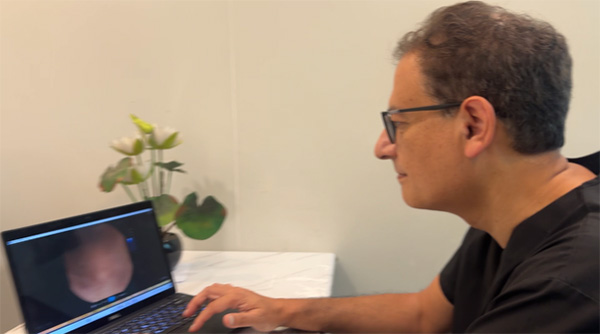
The useful question is not simply whether a capsule test is available. It is whether it is the right test, whether it can pass safely and whether the result is likely to change what happens next.
Dr Pranab reviews previous gastroscopy, colonoscopy, biopsy, imaging, blood and stool results before recommending capsule endoscopy. If the test proceeds, he interprets the recording in the context of the whole clinical picture and explains whether the findings require observation, further investigation, treatment or another procedure capable of taking a biopsy.
The capsule system used provides broad small bowel visual coverage. Equipment specifications can help image capture, but they do not replace preparation, safe patient selection or careful medical interpretation.
What capsule endoscopy cannot do
Capsule endoscopy cannot:
- take a biopsy
- remove a polyp
- stop active bleeding
- dilate a narrowing
- reliably assess disease outside the bowel wall
- guarantee that every abnormality will be seen
If treatment or tissue sampling is required, another procedure may be needed.
When to seek urgent medical advice
Do not wait for a routine capsule assessment if you have severe or worsening abdominal pain, repeated vomiting, marked abdominal swelling, inability to pass stool or wind, heavy bleeding, black stools with weakness or fainting, or signs of significant dehydration. Seek urgent medical care.
Related information
Small bowel and Crohn's disease
- Can a normal colonoscopy miss Crohn's disease?
- Crohn's disease care in Dubai
- MRI abdomen and MR enterography
- CT scan and CT enterography
Symptoms and investigations
Request a capsule endoscopy assessment
If capsule endoscopy has been suggested, or earlier tests have not explained a possible small bowel problem, request an assessment using the form below or contact the Admin Team on WhatsApp.
The consultation is used to decide whether capsule endoscopy is appropriate and whether a safety check is required before it is booked.