
By Dr Pranab Gyawali, Consultant Gastroenterologist (UK-trained) in Dubai
Watch the VLOG
In this VLOG, I explain what the Tasty&Healthy diet study actually tested, why it is different from general healthy eating, and why the result should not be used to stop Crohn's medicines when they are needed.
The key point is simple: this was a structured diet study in selected young people with Crohn's disease. It is promising, but it still needs medical supervision and objective monitoring.
Short answer
A structured plant rich whole food diet may reduce Crohn's inflammation in selected young people with mild to moderate Crohn's disease. In this 2025 randomised trial, the diet improved inflammatory markers including faecal calprotectin, CRP and ESR, and it was easier to tolerate than exclusive enteral nutrition.
The important caution is that this was a selected group. The trial included young people aged 6 to 25 who had not previously been treated with biologics, and it excluded severe or complicated Crohn's disease. It does not show that diet replaces biologics, steroids, surgery or other Crohn's medicines when they are needed.
So the answer is yes, diet can influence inflammation in Crohn's disease for some patients. But it should be used as part of supervised IBD care, with objective monitoring, not as a reason to stop treatment that is medically necessary.
As a consultant gastroenterologist looking after patients with Crohn's disease and ulcerative colitis for more than 25 years, I have seen how important diet can be. Patients want to know whether a plant rich whole food diet can lower faecal calprotectin, whether it can calm Crohn's inflammation, and whether it can offer an alternative to formula only nutrition. This study matters because it starts to answer those questions with measurable inflammation markers, not symptoms alone. For a broader starting point, see my introductory nutrition VLOG, What can I eat if I have IBD?.
What was the Tasty&Healthy diet?
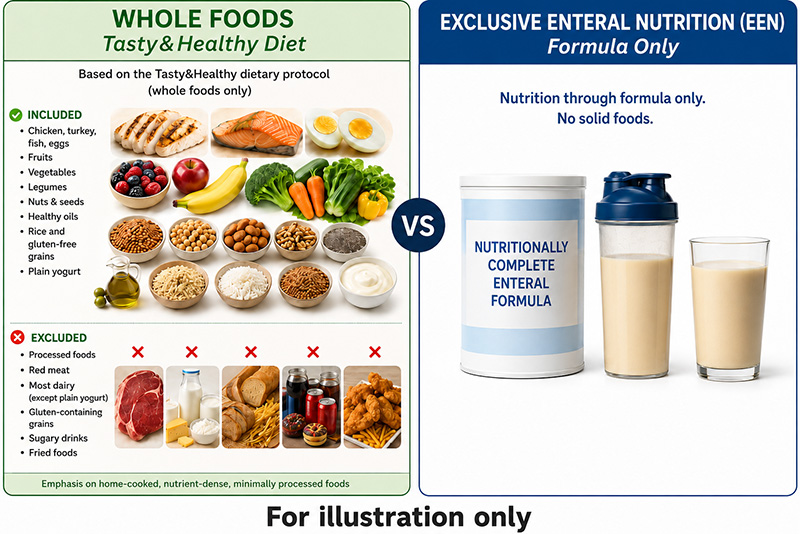
The Tasty&Healthy diet was a structured plant rich whole food diet. It was designed to reduce potentially inflammatory dietary exposures by excluding processed foods, gluten, red meat and most dairy. Plain yoghurt was allowed.
This matters because the study did not test gluten avoidance alone. It should not be interpreted as proof that gluten causes Crohn's disease. It tested a broader dietary protocol, with weekly dietary support.
It was also not the Crohn's disease exclusion diet. That distinction matters because patients may read about several different Crohn's nutrition protocols online. This vlog is about the Tasty&Healthy whole food protocol compared with exclusive enteral nutrition.
For wider Crohn's diet context, this sits alongside my earlier updates on plant based diet and Crohn's disease and whether food can help calm Crohn's disease.
What is exclusive enteral nutrition?
Exclusive enteral nutrition means replacing normal food with a nutritionally complete medical formula for a defined period. It is one of the best established dietary induction treatments in paediatric Crohn's disease, but many patients find it difficult to tolerate because it removes normal food and social eating.
For patients, the practical point is that EEN is a medical nutrition treatment, not a protein shake or supplement. It should be planned with an IBD team, especially if there is active inflammation, poor growth, weight loss or nutritional deficiency.
I have discussed this background separately in my VLOG on elemental diet in Crohn's disease and in the Crohn's VLOG on diet, infliximab and enteral nutrition.
Who was included in the study?
This was not a study of severe or complicated Crohn's disease. It studied young people aged 6 to 25 with mild to moderate Crohn's disease, early after diagnosis and biologic naive, meaning they had not previously been treated with biologics.
- Age 6 to 25
- Mild to moderate Crohn's disease
- Not previously treated with biologics
- Early disease
- Not severe or complicated Crohn's disease
Patients with stricturing disease, internal penetrating disease, previous bowel resection, draining perianal fistula, recent steroids or enteral nutrition, prior failed dietary treatment, coeliac disease or pregnancy were excluded.
What did the study show?
The study was called TASTI MM. It was a multicentre international randomised controlled trial of 83 young people with Crohn's disease. Forty one were assigned to Tasty&Healthy and 42 to exclusive enteral nutrition for 8 weeks.
| Result | Tasty&Healthy whole food diet | Exclusive enteral nutrition |
|---|---|---|
| Tolerability | 88 percent | 52 percent |
| Symptomatic remission | 56 percent | 38 percent |
| Calprotectin below 250 micrograms per gram | 34 percent | 33 percent |
| CRP, ESR and calprotectin | Decreased significantly | Decreased significantly |
| Microbiome diversity | Improved | Declined |
| Ruminococcus gnavus | Decreased | Increased |
The whole food diet appeared to stand up against exclusive enteral nutrition in selected young patients, while being much easier to tolerate. But I would not say the whole food diet was superior for remission. The remission rate was numerically higher with Tasty&Healthy, but the trial did not prove superiority.
Why the microbiome finding matters in Crohn's disease
One of the most interesting findings was the microbiome signal. The Tasty&Healthy group showed improved microbial diversity, while the EEN group showed reduced diversity. Ruminococcus gnavus, a species linked with bowel inflammation, decreased with Tasty&Healthy and increased with EEN.
This does not prove the whole mechanism, but it supports the idea that diet may affect Crohn's inflammation partly through the gut environment and microbiome. For related context, see the Gut Health Dubai pages on gut microbiome changes in Crohn's disease, diet and the IBD microbiome, and diet, calprotectin and Crohn's flare risk.
My clinical view
I am very positive about this kind of research. In clinic, the difficulty is often not only whether nutrition therapy can work. It is whether patients can actually tolerate it and live with it. This trial is helpful because randomized controlled trials of whole food approaches in Crohn's disease are still relatively uncommon, and this is an encouraging example of a plant rich whole food diet improving inflammation markers in selected young people with mild to moderate Crohn's disease.
The limitation is that this was not a study of the more severe or stubborn end of Crohn's disease. It excluded many patients who would need biologics or more intensive treatment. So I see this as positive progress in diet research, not as diet replacing advanced treatment when advanced treatment is needed. If diet is being used to treat inflammation, I would still want objective monitoring with faecal calprotectin, blood markers and, where needed, imaging or endoscopy.

Frequently asked questions
What is the best diet to reduce Crohn's inflammation?
There is no single best diet for every patient with Crohn's disease. In this trial, a structured plant rich whole food diet improved inflammation markers in selected young people with mild to moderate Crohn's disease, but diet still needs to be matched to disease severity, strictures, weight, symptoms and treatment plan.
Can diet lower faecal calprotectin in Crohn's disease?
Yes, diet may lower faecal calprotectin in some patients. In this study, calprotectin improved in the whole food diet group and in the exclusive enteral nutrition group. A high calprotectin still needs medical interpretation because symptoms alone do not reliably show whether inflammation is controlled.
Can I avoid formula only nutrition and use whole foods instead?
This study is encouraging because the whole food diet was easier to tolerate than formula only nutrition. But it does not prove that every patient can replace exclusive enteral nutrition with whole foods. The decision depends on age, disease severity, nutritional risk, inflammation level and the IBD team's plan.
Can diet replace biologics for Crohn's disease?
No. This trial focused on selected young people with mild to moderate Crohn's disease who had not previously received biologics. Diet can be an important part of Crohn's care, but it should not be used to avoid biologics when biologics are clinically needed.
Is this whole food diet the same as gluten free or the Crohn's disease exclusion diet?
No. Gluten was excluded, but the Tasty&Healthy diet also excluded processed foods, red meat and most dairy. It was also not the Crohn's disease exclusion diet. This was a specific whole food protocol with dietary support.
Is a whole food diet safe during a Crohn's flare?
A whole food diet is not automatically safe for every Crohn's flare. If there is severe inflammation, weight loss, vomiting, obstructive symptoms or a known stricture, fibre texture and food choices may need to be adjusted with an IBD team and dietitian.
This article is for general education and should not replace personal medical advice. If you have Crohn's disease and are considering a restrictive diet or exclusive enteral nutrition, please discuss this with your own gastroenterology and dietetic team.
Recommended related reading
Crohn's disease foundations
Diet and Crohn's disease VLOGs
- What can I eat if I have IBD?
- Elemental diet in Crohn's disease
- Crohn's disease diet, infliximab and enteral nutrition
- Plant based diet and Crohn's disease
- Crohn's diet research and fasting mimicking diet
- Diet, calprotectin and flare prediction in Crohn's disease and ulcerative colitis
- Bread, processed grains and IBD risk
- Red meat, Crohn's disease, ulcerative colitis and the microbiome
Crohn's microbiome and diet context
- Is your gut microbiome behind Crohn's disease flares?
- Diet, microbiome and IBD
- Before you take another probiotic: what Akkermansia teaches us
Crohn's treatment and monitoring VLOGs
- Predicting severe Crohn's disease and ulcerative colitis earlier
- High calprotectin with a normal CRP in IBD
- Why a biologic may stop working in IBD
- Will infliximab work for you?
- IBD treatment update 2026