
By Dr Pranab Gyawali, Consultant Gastroenterologist (UK-trained) in Dubai
Many people with Crohn’s disease ask a very important question: if I am already taking a biologic such as infliximab, does diet still matter?
This is a reasonable question. Crohn’s disease is not only about immune pathways. It also happens inside the gut environment, where food, the microbiome, the gut lining and inflammation interact every day.
In this video, Dr. Pranab, a UK-trained gastroenterologist in Dubai, explains why recent research into enteral nutrition and biologics may help us think differently about Crohn’s disease treatment.
For people who want to understand more about elemental diet, enteral nutrition and Crohn’s disease, please read this related guide: elemental diet and Crohn’s disease.
Watch the video
Why diet keeps coming up in Crohn’s disease
Many Crohn’s patients feel that medical discussions focus heavily on biologics, steroids, immunosuppressants and advanced therapies.
Those treatments are important. But patients also know that Crohn’s disease is felt in the gut. Food can trigger symptoms. Flares can affect eating. The microbiome can change. The gut lining can become inflamed, ulcerated and fragile.
So the question is not simply: diet or biologics?
A better question may be: can we treat the immune pathway and also improve the gut environment?
The immune pathway and the gut environment pathway
Crohn’s disease treatment often focuses on immune pathways. These include pathways such as TNF, IL 23, JAK signalling and integrins.
But there is another important side to Crohn’s disease: the gut environment. This includes the microbiome, the gut lining and the inflammatory conditions inside the bowel.
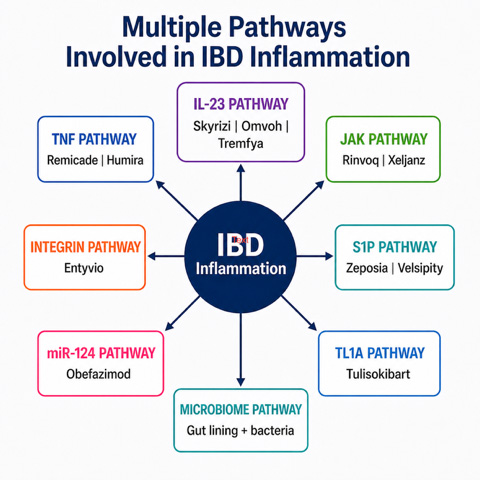
This is why research into diet, enteral nutrition, FMT and next generation probiotics is becoming so interesting in Crohn’s disease. These approaches may not replace biologics, but they may help us understand the gut environment that keeps inflammation active.
What is exclusive enteral nutrition?
Exclusive enteral nutrition means replacing normal food with a nutritionally complete medical formula for a defined period.
It is commonly used in children with Crohn’s disease and is often taken by mouth as liquid nutrition. In some patients, especially if drinking enough formula is difficult, it may be given through a feeding tube.
It is not the same as ordinary protein shakes or supermarket supplements. Specialist formulas are designed to provide medically supervised nutrition, usually including calories, protein, carbohydrate, fat, vitamins and minerals, depending on the formula used.
Why exclusive enteral nutrition is easier to use in children than adults
Exclusive enteral nutrition can work very well in children with Crohn’s disease, but it is often difficult for adults to sustain.
| Issue | Why it matters in adults |
|---|---|
| Social eating | Adults often struggle to stop normal food completely. |
| Work and family life | Formula only treatment can be hard to follow around daily routines. |
| Taste and volume | Some patients find the amount of formula difficult. |
| Psychological burden | Food restriction can feel isolating. |
| Long term practicality | Adults often need a more realistic strategy. |
This is why partial enteral nutrition is increasingly interesting.
What is partial enteral nutrition?
Partial enteral nutrition means that part of daily calories come from specialist formula, while the person still eats selected food.
In other words, it is not full liquid nutrition. It is a mixture of medical nutrition and food.
| Type of nutrition | What it means | Practical issue |
|---|---|---|
| Exclusive enteral nutrition | Formula replaces normal food. | Stronger dietary intervention, but hard for many adults. |
| Partial enteral nutrition | Formula provides part of calories, with food still allowed. | More realistic for many adults. |
| Regular diet | Normal food without prescribed formula. | Easier, but may not provide the same therapeutic nutrition strategy. |
What did the 2026 review on biologics and enteral nutrition suggest?
A recent review in the Journal of Crohn’s and Colitis looked at exclusive enteral nutrition combined with biologics in adults with Crohn’s disease.
The biologics reviewed included anti TNF agents, vedolizumab and ustekinumab. This means the review was not only an infliximab paper, although infliximab is part of the anti TNF category.
The review suggested that combining exclusive enteral nutrition with biologics may improve clinical and endoscopic remission compared with biologics alone. However, the authors also made it clear that the evidence is promising but still limited, with many studies being small or retrospective.
You can find the study on biologics here.
What did the 2025 infliximab and partial enteral nutrition study show?
A 2025 cohort study looked specifically at Crohn’s patients treated with infliximab.
This is the more directly relevant paper if we want to talk about infliximab.
| Group | Treatment approach |
|---|---|
| Group 1 | Infliximab alone |
| Group 2 | Infliximab plus partial enteral nutrition |
The paper defined partial enteral nutrition as receiving at least half of daily energy requirements from enteral nutrition. Daily energy requirement was calculated as 30 to 35 kcal per kg per day.
The paper did not provide a detailed Mediterranean diet food list or specific allowed foods.
Key results from the infliximab study
| Outcome | Infliximab alone | Infliximab plus partial enteral nutrition |
|---|---|---|
| Clinical response at 14 weeks | 74.75% | 87.01% |
| Endoscopic remission at 54 weeks | 65.66% | 84.42% |
The headline number is the 54 week endoscopic remission result.
Endoscopic remission was 84.42% with infliximab plus partial enteral nutrition, compared with 65.66% with infliximab alone.
That is not a small difference. However, this was a cohort study, not a definitive randomized controlled trial. It should be seen as an important signal, not proof that every Crohn’s patient should start partial enteral nutrition.
You can find the study on infliximab comparison here.
What type of liquid nutrition are we talking about?
In this context, enteral nutrition usually means a nutritionally complete medical formula.
| Route | Meaning |
|---|---|
| By mouth | The patient drinks the formula. |
| By feeding tube | Formula is delivered directly into the gut if oral intake is not enough. |
This is not the same as ordinary gym protein shakes.
Some Crohn’s formulas are polymeric formulas, meaning they contain whole protein. Modulen IBD is one example often discussed in Crohn’s disease. It is not an elemental formula. It is a whole protein, casein based formula used under medical supervision.
The exact formula used depends on the patient, country, tolerance, availability and dietitian or IBD team guidance.
Is this the same as Modulen plus a Mediterranean diet?
Not exactly.
The 2025 infliximab paper defined partial enteral nutrition by the proportion of calories coming from enteral nutrition. It did not provide a clear Mediterranean diet plan or a detailed list of allowed foods.
So it would be inaccurate to say:
This study proves Modulen plus Mediterranean diet improves infliximab response.
A safer interpretation is:
This study suggests that adding partial enteral nutrition to infliximab may improve outcomes in Crohn’s disease.
Why might enteral nutrition help in Crohn’s disease?
The exact mechanism is still being studied, but several possibilities are biologically plausible.
| Possible mechanism | Why it may matter |
|---|---|
| Reduced dietary inflammatory load | Formula nutrition may reduce exposure to certain dietary components that aggravate inflammation. |
| Microbiome shift | Enteral nutrition may alter gut bacteria and gut microbial activity. |
| Gut lining support | Better nutrition may support mucosal healing and barrier repair. |
| Lower inflammatory baseline | If the gut environment becomes less inflamed, biologics may have a better chance to work. |
| Improved nutritional status | Poor nutrition can worsen outcomes in Crohn’s disease. |
This is where the pathway concept becomes important. Infliximab blocks an immune pathway. Partial enteral nutrition may act more through the gut environment pathway.
What does this mean for Crohn’s patients?
This does not mean diet replaces biologics.
It also does not mean everyone with Crohn’s disease should start enteral nutrition without medical supervision.
But it does suggest that Crohn’s treatment may need to look at both sides:
| Treatment angle | Clinical question |
|---|---|
| Immune pathway | Which inflammatory signal should we block? |
| Gut environment pathway | What is happening in the microbiome, gut lining and bowel environment? |
For selected patients, especially those struggling to achieve deeper healing, nutrition may need to be part of the structured treatment conversation.
Who should not try this alone?
Enteral nutrition should be supervised, especially if someone has:
| Situation | Why supervision matters |
|---|---|
| Significant weight loss | There may be risk of undernutrition or refeeding issues. |
| Stricturing Crohn’s disease | Diet texture and obstruction risk need assessment. |
| Active flare | Medical treatment may need urgent adjustment. |
| Diabetes or kidney disease | Formula choice may matter. |
| Children or teenagers | Growth and nutrition need specialist monitoring. |
| Pregnancy | Nutritional adequacy is critical. |
| Existing biologic treatment | Changes should be coordinated with the IBD team. |
Key takeaways
| Question | Practical answer |
|---|---|
| Does diet matter in Crohn’s disease? | Yes, but it should not be oversimplified. |
| Does this replace infliximab? | No. |
| Was the 2026 review only about infliximab? | No. It reviewed biologics including anti TNF agents, vedolizumab and ustekinumab. |
| Was the 2025 study specifically about infliximab? | Yes. |
| What was the headline result? | 84.42% endoscopic remission with infliximab plus partial enteral nutrition versus 65.66% with infliximab alone. |
| Should patients start this alone? | No. It should be discussed with a gastroenterologist or IBD dietitian. |
My view
The important message is not that diet is an alternative to biologics.
The important message is that Crohn’s disease is not only an immune pathway disease. It is also a gut environment disease.
The future of Crohn’s treatment is likely to include more studies that work from both angles: the immune pathway and the gut environment pathway.
That is why I keep paying attention to research on enteral nutrition, microbiome therapy, FMT and next generation probiotics.
If we want deeper healing in Crohn’s disease, we cannot ignore the environment inside the gut itself.
Frequently asked questions
Can diet help infliximab work better in Crohn’s disease?
Possibly in selected patients. A 2025 cohort study found higher endoscopic remission at 54 weeks in Crohn’s patients treated with infliximab plus partial enteral nutrition compared with infliximab alone. This is promising, but it is not definitive proof.
What is partial enteral nutrition?
Partial enteral nutrition means part of daily calorie intake comes from specialist medical formula, while the person still eats selected food.
Is partial enteral nutrition the same as tube feeding?
Not necessarily. Many patients take enteral nutrition by drinking formula. Tube feeding is only needed if someone cannot drink enough or if the medical situation requires it.
Is Modulen an elemental formula?
No. Modulen IBD is generally described as a whole protein, casein based formula. It is a medical nutrition product used in Crohn’s disease under supervision.
Did the infliximab study use a Mediterranean diet?
The 2025 paper did not provide a detailed Mediterranean diet plan or exact allowed food list. It defined partial enteral nutrition by energy intake from enteral nutrition.
Can I use protein shakes instead?
No. Ordinary protein shakes are not the same as nutritionally complete medical enteral formulas used in Crohn’s disease.
Should I start enteral nutrition if I am on infliximab?
Do not start this without medical advice. It should be discussed with your gastroenterologist and ideally an IBD dietitian, especially if you are in a flare, losing weight, or have stricturing disease.
Recommended Guides
Crohn’s disease essentials
- AI in Crohn’s and Ulcerative Colitis: Can Machine Learning Predict IBD Treatment Response?
- Crohn’s disease symptoms, tests and treatment in Dubai
- Crohn’s VLOG
- Crohn’s and ulcerative colitis VLOG
Crohn’s biologics and advanced treatment
- Learn about Biologicals used in UC and Crohn’s in Dubai
- Predicting biologic treatment success in Crohn’s and ulcerative colitis
- Predicting vedolizumab response in IBD
- Stelara versus Skyrizi in Crohn’s disease
- Vedolizumab in Crohn’s disease timing
- Rinvoq in Crohn’s disease
- Tremfya explained for Crohn’s and ulcerative colitis
- Crohn’s surgery versus infliximab in Dubai
- Why not to stay on steroids in Crohn’s and colitis
Crohn’s diet and nutrition
- Elemental diet and Crohn’s disease
- Plant based diet in Crohn’s disease
- Crohn’s disease diet, 3 gut friendly foods
- Can food help calm Crohn’s disease?
- 3 foods to avoid in Crohn’s and colitis
- Diet and microbiome influence on biologic response
- Oxygen Trap and diet in IBD
- Diet and microbiome in IBD
Microbiome and gut environment
- Gut microbiome gastroenterologist in Dubai
- Gut microbiome test in Dubai
- FMT and infliximab biologics IBD microbiome
- Next generation probiotics in IBD
- Engineered probiotic for ulcerative colitis
- Gut microbiome behind Crohn’s flares
- Leaky gut in Crohn’s and ulcerative colitis
- 4 science backed gut barrier tips
- SIBO in Crohn’s and ulcerative colitis
- Gut bacteria anti inflammatory breakthrough
If you wish to discuss this further or would like to make an appointment, please use the booking form on this page. A member of our team will contact you within 12 business hours.