
What is new?
This page was first published as a practical guide to predicting infliximab response. It now includes a new video and updated evidence on HLA-DQA1*05 and other biomarkers. The original information about infliximab brands, smoking, albumin and what happens if treatment does not work remains part of the guide.
Can a blood test predict whether infliximab will work?
No blood test can tell you with certainty. HLA-DQA1*05 is linked with a higher chance of developing antibodies against infliximab or adalimumab. It is an antibody-risk marker, not proof that infliximab will fail. The most useful assessment still combines the pattern and severity of the IBD, smoking, albumin, previous treatment and safety.
Patients often ask me, “Can you tell whether this will work for me?” It is a fair question. We can estimate some risks, but we cannot yet choose the right IBD treatment from one blood sample.
This updated VLOG explains what doctors can assess now, what HLA-DQA1*05 actually tells us, and which biomarkers are still being researched.
I am a consultant gastroenterologist, MBBS (London), FRCP (UK), with more than 25 years of clinical experience. I regularly help people with Crohn's disease and ulcerative colitis make these treatment decisions.
What is infliximab?
Infliximab is an anti-TNF biologic used for moderate to severe Crohn's disease and ulcerative colitis. It may be known by the original trade name Remicade or by biosimilar names such as Inflectra, Remsima, Flixabi or Ixifi. Availability varies between countries.
These products contain versions of the same active medicine. The clinical factors and biomarkers discussed on this page apply to infliximab regardless of brand.
What can doctors assess before infliximab starts?
Before looking at a genetic marker, the basic clinical information often tells us more.
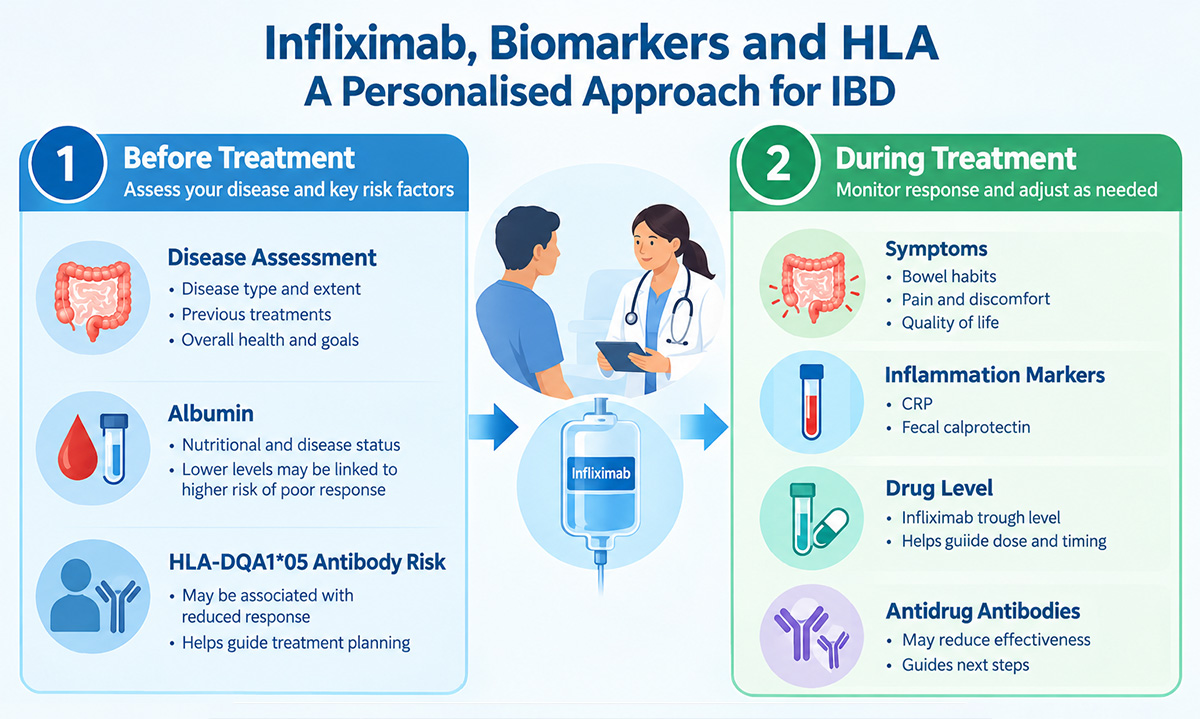
- Disease pattern and severity: we look at where the inflammation is, how active it is and whether there is narrowing, penetrating disease or another complication.
- Smoking: in Crohn's disease, smoking is linked with a more difficult disease course and poorer treatment outcomes. Stopping smoking is one factor a patient can change.
- Albumin: a low albumin level can accompany severe inflammation and faster removal of infliximab from the blood. This may affect dosing and monitoring.
- Previous treatment and safety: we review what has already been tried, infection screening and other health factors.
None of these gives a simple yes or no answer. Together, they help the IBD team plan treatment and monitoring.
What does HLA-DQA1*05 tell us about anti-TNF antibodies?
HLA-DQA1*05 is a genetic variant. People who carry it appear more likely to develop antibodies against infliximab or adalimumab.
These antibodies can remove the medicine from the blood more quickly or make it less reliable. The important word is risk. Many people who carry HLA-DQA1*05 still do well on infliximab. Some people who do not carry it still develop antibodies. The result does not measure bowel inflammation or show which treatment will work best.
What do the studies show?
Taken together, the evidence is stronger for antibody risk than for predicting treatment success or failure.
Is antibody risk the same as predicting infliximab response?
No. Developing antibodies is one reason a treatment may lose effect. It is not the only reason.
Infliximab may not control the disease if TNF is not the main driver of inflammation. It can also be removed from the body too quickly, particularly when inflammation is severe or albumin is low. Sometimes symptoms continue even though active inflammation is no longer the main problem.
This is why a positive HLA-DQA1*05 result should never be translated as “infliximab will not work”.
| Question | What may help | What it cannot decide alone |
|---|---|---|
| Are antibodies more likely? | HLA-DQA1*05 may refine the estimate | Whether antibodies will definitely develop |
| Could infliximab be cleared quickly? | Albumin and inflammatory burden | The exact dose every patient will need |
| Is treatment working after it starts? | Symptoms, biomarkers, endoscopy or imaging | This is follow-up monitoring, not a pretreatment genetic prediction |
Which emerging biomarkers might improve future IBD decisions?
Oncostatin M and TREM1 are among the markers being studied to see whether they can help predict response to anti-TNF treatment. Immune, tissue, genetic and microbiome information may eventually be combined to guide treatment more accurately.
These are research tools, not routine standalone tests. Other biomarkers answer different questions:
- HLA-DRB1*01:03 and anti-IL-10 antibodies are being studied as clues to disease severity.
- A separate genetic marker has been reported in relation to ustekinumab response.
- Anti-alpha-v-beta-6 antibodies have been studied in relation to vedolizumab response.
Which tests become useful after infliximab has started?
Once treatment has begun, the question changes. We need to know whether inflammation is improving and whether enough infliximab remains in the body.
Symptoms are useful, but they are not enough on their own. Faecal calprotectin, CRP, albumin, endoscopy or scans may be needed. In some situations, infliximab levels and antibody tests can help explain a partial response or a later loss of response.
This is different from using HLA-DQA1*05 before treatment. The separate guide on infliximab and adalimumab levels and antibodies explains it in more detail.
What if infliximab does not work?
It does not mean that treatment options are exhausted. First, the team checks whether active inflammation is still present and whether there is a complication that needs a different approach.
If the infliximab level is low or antibodies are present, the team may review the dose, timing or treatment strategy. If there is enough drug in the blood but inflammation remains active, a medicine working through a different immune pathway may be more appropriate.
The next step depends on why treatment has not worked, not simply on the fact that symptoms continue.
What are the evidence limitations?
The HLA studies mainly show associations. They do not prove that testing every patient before treatment leads to a better outcome.
The studies also used different definitions and monitoring plans. Evidence linking HLA-DQA1*05 with antibody formation is stronger than evidence that it predicts treatment failure. The test may add useful information, but it does not replace a clinical decision.
What does this mean in practice?
Before starting infliximab, it helps to ask what the team is trying to predict. Is the main concern severe disease, rapid removal of the drug from the body, antibody formation, infection risk or whether another type of treatment may suit the disease better?
If HLA-DQA1*05 testing is available, it may help with the discussion about treatment and monitoring. It should not be read as a pass or fail result. Do not delay or change treatment because of a genetic result without discussing it with your IBD team.
My clinical view
I welcome tests that may make IBD treatment less dependent on trial and error. But a biomarker is useful only if it helps us make a better decision, not simply because it produces an interesting result.
HLA-DQA1*05 tells us something about antibody risk. It does not tell me, by itself, that infliximab is the wrong treatment. For now, the best decisions still combine the disease pattern, objective inflammation, safety and the patient's preferences.
Would you like more evidence-based IBD updates?
Choose Gut Health Dubai as a Preferred Source on Google so future Crohn's disease, ulcerative colitis and treatment updates are easier to find.
Frequently asked questions
Can a genetic blood test tell whether infliximab will work?
No. HLA-DQA1*05 may indicate higher antidrug antibody risk, but it does not prove infliximab will fail.
What does a positive HLA-DQA1*05 result mean?
It means a variant associated with higher anti-TNF immunogenicity risk is present. It must be interpreted with the planned medicine, disease severity, albumin and monitoring strategy.
Should HLA-DQA1*05 automatically change the chosen biologic?
No. Evidence does not support an automatic treatment switch based on this result alone.
How is HLA testing different from infliximab levels and antibodies?
HLA testing estimates genetic risk. Drug levels and antidrug antibody tests measure what is happening after infliximab has been given.
Research sources
This page is for general education and does not replace personal medical advice. Do not start, stop, delay or change infliximab or another IBD treatment because of a biomarker result without speaking to your gastroenterologist or IBD team.
Recommended related reading
If you would like to discuss an IBD treatment decision with Dr Pranab Gyawali, you can use the appointment form below.