
Written and medically reviewed by: Dr Pranab Gyawali, UK-trained Consultant Gastroenterologist with over 25 years' experience in inflammatory bowel disease.
Short Answer
Yes, partly, but not perfectly yet. Current tools such as CRP, albumin, haemoglobin, faecal calprotectin, colonoscopy, imaging and treatment response help doctors estimate risk. Newer research is now pointing to blood antibody markers, genetic markers and microbiome patterns. AI may eventually help combine these signals into a more accurate risk picture.
In clinic, we already try to estimate whether Crohn's disease or ulcerative colitis is likely to behave mildly or more aggressively. We look at symptoms, blood tests, stool calprotectin, colonoscopy, imaging, nutrition, previous flares and response to treatment.
Those clues are useful. They are not a crystal ball.
Recent research is now pointing to three newer prediction directions: blood antibody markers, genetic markers and microbiome patterns. In the future, AI may help combine these with the information gastroenterologists already use, so higher-risk patients can be recognised earlier.
That does not mean one simple test can predict everything today. It means the field is moving towards a more precise way of understanding risk.
Watch the Video
Predicting Severe Crohn's and Ulcerative Colitis Earlier
New Research Findings
This short video explains why prediction in IBD is changing. The important message is not that these tests are routine decision tools already. They are not. The message is that research is beginning to identify biological patterns that may explain why some patients have a more severe course than others.
Is There a Blood Test to Predict Severe Crohn's or Ulcerative Colitis?
There is no single routine blood test that can predict every patient's future.
Today, doctors use tests such as CRP, albumin and haemoglobin to understand inflammation, nutrition and the wider impact of disease. We also use faecal (fecal) calprotectin to monitor bowel inflammation more directly.
These tests matter. A patient with repeated inflammation, anaemia, low albumin, high calprotectin or early complications may need closer monitoring and sometimes earlier advanced treatment discussions.
But these tests do not tell us the whole future course of Crohn's disease or ulcerative colitis.
One newer research direction involves neutralising anti-IL-10 autoantibodies.
IL-10 is one of the body's natural anti-inflammatory signals. A simple way to think about it is as a brake on inflammation. If antibodies interfere with IL-10, that brake may not work properly in a small subgroup of patients.
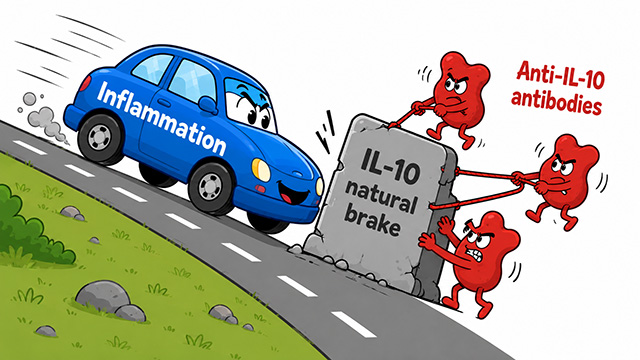
This research began with children who had very early-onset IBD, where scientists found antibodies blocking IL-10. More recent adult IBD research reported neutralising anti-IL-10 autoantibodies in 173 of 4,909 patients, about 3.5%.
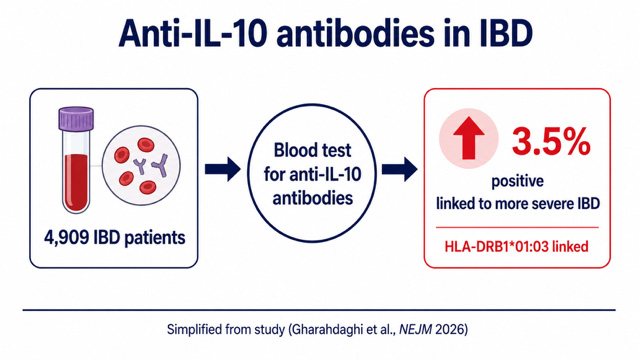
That is a small subgroup, not most patients with IBD.
But it is clinically interesting because it may point to a recognisable type of disease biology. This research may support development of a future blood test to identify an IL-10-antibody-positive subgroup. It may also point towards future treatments that target the antibodies themselves, or the immune cells producing them.
This is not a routine IBD clinic blood test yet.
Can a Genetic Marker Predict Severe Crohn's or Ulcerative Colitis?
The genetic marker in this story is HLA-DRB1*01:03.
The IL-10 antibody research found that neutralising anti-IL-10 autoantibodies were strongly associated with HLA-DRB1*01:03. A separate genetics study has also linked HLA-DRB1*01:03 with more severe outcomes in both Crohn's disease and ulcerative colitis.
That connection matters because it brings two pieces of information together:
- a blood antibody finding;
- a genetic marker linked with more severe IBD behaviour.
This does not mean the marker is destiny. It does not mean every person with HLA-DRB1*01:03 will definitely have severe Crohn's disease or severe ulcerative colitis.
But it may eventually help identify patients who need closer monitoring, earlier escalation discussions or a lower threshold for checking whether inflammation is truly under control.
At the moment, it should not be treated as a standalone treatment decision tool.
Can Microbiome Patterns Predict Severe IBD?
The microbiome is another important direction.
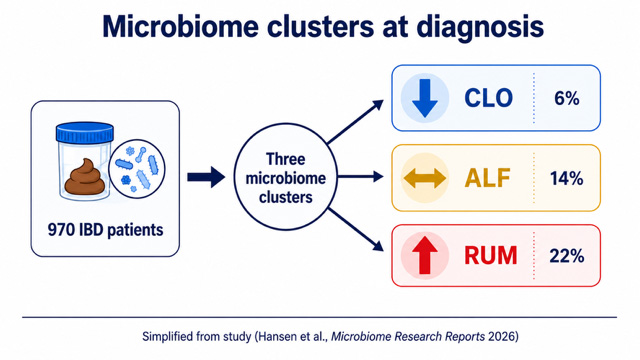
The key point is not that one single bacterium predicts the future. That would be too simple. Microbiome research suggests that risk information may sit in broader bacterial patterns, or clusters, especially when those patterns are combined with clinical information.
A study of newly diagnosed IBD patients found microbiome cluster patterns linked with different disease-course outcomes over time. The existing page already includes a microbiome cluster visual, and that should be kept.
This is where AI becomes relevant.
Microbiome data is complex. Genetics is complex. Antibody data is complex. Colonoscopy, imaging, CRP, albumin, haemoglobin, calprotectin and treatment response add more layers.
AI may eventually help combine complex information from blood tests, stool calprotectin, microbiome patterns, genetics, colonoscopy, imaging and treatment response. The aim is not for AI to replace the gastroenterologist, but to support better risk prediction and more individualised decisions.
The realistic future is probably not one magic test.
It is several useful signals brought together.
Related video: Microbiome patterns, AI and predicting IBD course
What Does This Mean for Patients?
The positive message is not that we can predict every patient's future today.
We cannot.
The positive message is that IBD care is becoming more precise. Instead of only using broad labels such as Crohn's disease and ulcerative colitis, research is beginning to ask why one patient's inflammation behaves differently from another's.
In practical terms, the future may involve:
- blood tests that identify antibody-positive subgroups, including patients with neutralising anti-IL-10 autoantibodies;
- genetic markers such as HLA-DRB1*01:03 that help recognise higher-risk patients;
- microbiome patterns that add another layer of risk information;
- AI-supported models that combine these findings with ordinary clinical assessment.
My view is that this research is encouraging, but it should be kept in proportion.
Patients should not come away thinking they must urgently arrange private genetic or antibody testing. These are not routine standalone decision tools yet. But they do show where IBD care is moving: earlier recognition of higher-risk disease, closer monitoring where it matters and more individualised treatment discussions.

Frequently Asked Questions
Is there a blood test that predicts severe Crohn's or ulcerative colitis?
There is no single routine blood test that predicts every patient's future. Current blood tests such as CRP, albumin and haemoglobin help assess inflammation and disease impact. Recent research is now pointing to more specific blood markers, including neutralising anti-IL-10 autoantibodies.
What are neutralising anti-IL-10 autoantibodies?
They are antibodies that block IL-10, one of the body's natural anti-inflammatory signals. If IL-10 is blocked, inflammation may become harder to control in a small subgroup of patients.
Is the IL-10 antibody blood test available now?
Not as a routine IBD clinic test. This research may support development of a future blood test to identify an IL-10-antibody-positive subgroup, but it is not currently a standard test used to guide Crohn's or ulcerative colitis treatment.
Can genetic testing predict severe IBD?
Not perfectly. Recent research suggests HLA-DRB1*01:03 is associated with more severe Crohn's and ulcerative colitis outcomes and may eventually help identify higher-risk patients.
Does HLA-DRB1*01:03 mean I will definitely have severe IBD?
No. It is a risk marker, not a guarantee. It may eventually help guide closer monitoring or earlier advanced treatment discussions.
Can microbiome testing predict severe IBD?
Not reliably in routine clinical practice yet. But microbiome research suggests bacterial patterns may help predict disease course when combined with other markers.
How could AI help predict severe IBD?
AI may help combine complex information from blood tests, stool tests, microbiome data, genetics, colonoscopy, imaging and treatment response. The aim is to support better prediction, not to replace clinical judgement.
Research Used in This Article
The main research discussed in this article is listed below. These links are included so patients and clinicians can see the evidence behind the page.
- New England Journal of Medicine 2026 study on neutralising anti-IL-10 autoantibodies in IBD.
- 2026 genetics study linking HLA-DRB1*01:03 with severe Crohn's disease and ulcerative colitis outcomes.
- Microbiome cluster study currently used on the existing page.
Monitoring and Prediction
- High calprotectin but normal CRP
- Diet, calprotectin and flare prediction
- Smartwatch, AI and calprotectin flare prediction
Microbiome and IBD Course
- Gut microbiome in Crohn's disease and ulcerative colitis
- Diet, microbiome and IBD
- Probiotics, Akkermansia and gut health
Treatment Decisions
Important Note
This page is for education only and is not personal medical advice. If you have Crohn's disease or ulcerative colitis, decisions about testing, monitoring and treatment should be made with your own gastroenterology team.