
By Dr Pranab Gyawali, Consultant Gastroenterologist
So let me explain clearly and scientifically.
What Is Leaky Gut?
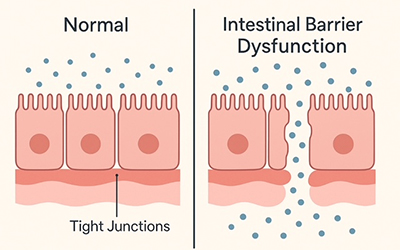
Leaky gut is a popular term, but in medical language, we refer to it as intestinal barrier dysfunction or increased intestinal permeability. This means the lining of the gut becomes weakened or damaged, allowing bacteria, toxins, or undigested food particles to “leak” into the bloodstream.
In a healthy gut, tight junction proteins keep the intestinal lining sealed. But in people with IBD, those tight junctions can be disrupted—leading to a cascade of inflammation, immune activation, and worsening symptoms.
How Leaky Gut Differs in Crohn’s vs. Ulcerative Colitis
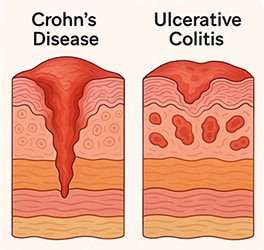
One of the most important things to understand is that leaky gut does not behave the same way in Crohn’s and UC.
Crohn’s Disease
In Crohn’s, intestinal barrier dysfunction can occur even before visible inflammation.
Studies have shown that relatives of Crohn’s patients can have increased gut permeability, suggesting that a “leaky gut” might play a role in triggering the disease.
The inflammation in Crohn’s is transmural—affecting all layers of the bowel wall—so barrier disruption can be deep and long-lasting.
Ulcerative Colitis
In UC, inflammation is typically limited to the mucosal layer (the surface of the colon).
Leaky gut in UC is usually a result of inflammation, not the cause.
However, during flares, the barrier can become severely compromised—and even during remission, subtle dysfunction may persist.
Why This Matters for Patients in Dubai
In my IBD clinic in Dubai, I see many patients who are overwhelmed by online advice and supplements promising to “fix” leaky gut. While there is some truth behind gut barrier dysfunction, it’s critical to separate science from hype.
What matters most is understanding:
- The mechanisms of barrier damage
- How they differ between Crohn’s and UC
- And how we can address them through real, evidence-based care
What Symptoms Might Suggest Barrier Dysfunction?
Even during IBD remission, you might still experience:
- Bloating or cramping
- Food sensitivities
- Fatigue or brain fog
- Skin issues or joint aches
These may not be due to active inflammation, but rather to a gut lining that’s still struggling to recover.
So What’s Next?
In Part 2 of this video series, I’ll explain:
How we can support the gut lining
What foods and microbiome strategies are backed by research
And which supplements might help—used in the right context
But most importantly, these strategies are meant to support—not replace—your medical treatment.
If you’re on medications like Imuran, Asacol, or biologics, don’t stop them. Supporting the gut barrier is an adjunct, not an alternative.
Recommended Guides:
FMT, Probiotics and Next-Generation Microbiome Therapies
- AI in Crohn’s and Ulcerative Colitis: Can Machine Learning Predict IBD Treatment Response?
- FMT and infliximab in IBD: could the microbiome help biologics work better?
- Fecal microbiota transplant for Crohn’s disease and ulcerative colitis
- Probiotics for Crohn’s and ulcerative colitis: what actually works?
- Probiotics in ulcerative colitis: what does the MB310 trial mean?
- Engineered probiotic for ulcerative colitis 2026
- Probiotics for ulcerative colitis: what actually works?
Gut Microbiome, Diet and Treatment Response
- Diet and microbiome in IBD: how the right bacteria calm gut inflammation
- Gut microbiome in Crohn’s disease and ulcerative colitis
- How the Oxygen Trap may be driving your IBD, and why diet still matters
- IBD flare risk, diet and calprotectin
- IBD breakthrough: how gut bacteria unlock natural anti-inflammatories
- Gut microbiome test in Dubai
Crohn’s, Colitis and Biologic Treatment Strategy
- Learn about Biologicals used in UC and Crohn’s in Dubai
- Crohn’s disease specialist care in Dubai
- Ulcerative colitis specialist care in Dubai
- How biologics work in Crohn’s and colitis
- How we choose the right biologic for Crohn’s and UC in Dubai
- New omics research: predicting response to biologics in Crohn’s and ulcerative colitis
Investigations and Procedures
- Colonoscopy for Crohn’s and ulcerative colitis monitoring
- Capsule endoscopy for small bowel Crohn’s disease
- MRI abdomen and MR enterography
- CT abdomen and CT enterography
- Hydrogen and methane breath test for SIBO
If you wish to discuss this further or would like to make an appointment, please use the booking form on this page.