
By Dr Pranab Gyawali, Consultant Gastroenterologist (UK-trained) in Dubai
What trough levels and antibodies may mean in Crohn's disease and ulcerative colitis
If you take infliximab or adalimumab for Crohn's disease or ulcerative colitis, your IBD team may at some point talk about your drug “level” or “antibodies”. These terms matter, but they are often explained too quickly.
I have made this VLOG because patients regularly ask me what the numbers mean and whether a low result means their biologic has failed.
Short answer
A trough level tells us how much infliximab or adalimumab remains in your blood immediately before the next dose is due.
Antidrug antibodies are proteins made by the immune system that can attach to the medicine. In some patients, they make the drug disappear more quickly or work less reliably.
A low trough level does not automatically mean the biologic has failed. Active inflammation, loss of protein and drug through a severely inflamed bowel, and antidrug antibodies can all lower the level. The result needs to be considered alongside your symptoms, faecal calprotectin, CRP, albumin, treatment goals and, when needed, endoscopy or imaging.
This approach is called therapeutic drug monitoring. It is best established for anti-TNF medicines, particularly infliximab and adalimumab. An adult IBD literature review and expert consensus statement supports using drug and antibody results to investigate primary non-response or loss of response. It does not give us one universal number that suits every patient.
Watch the video
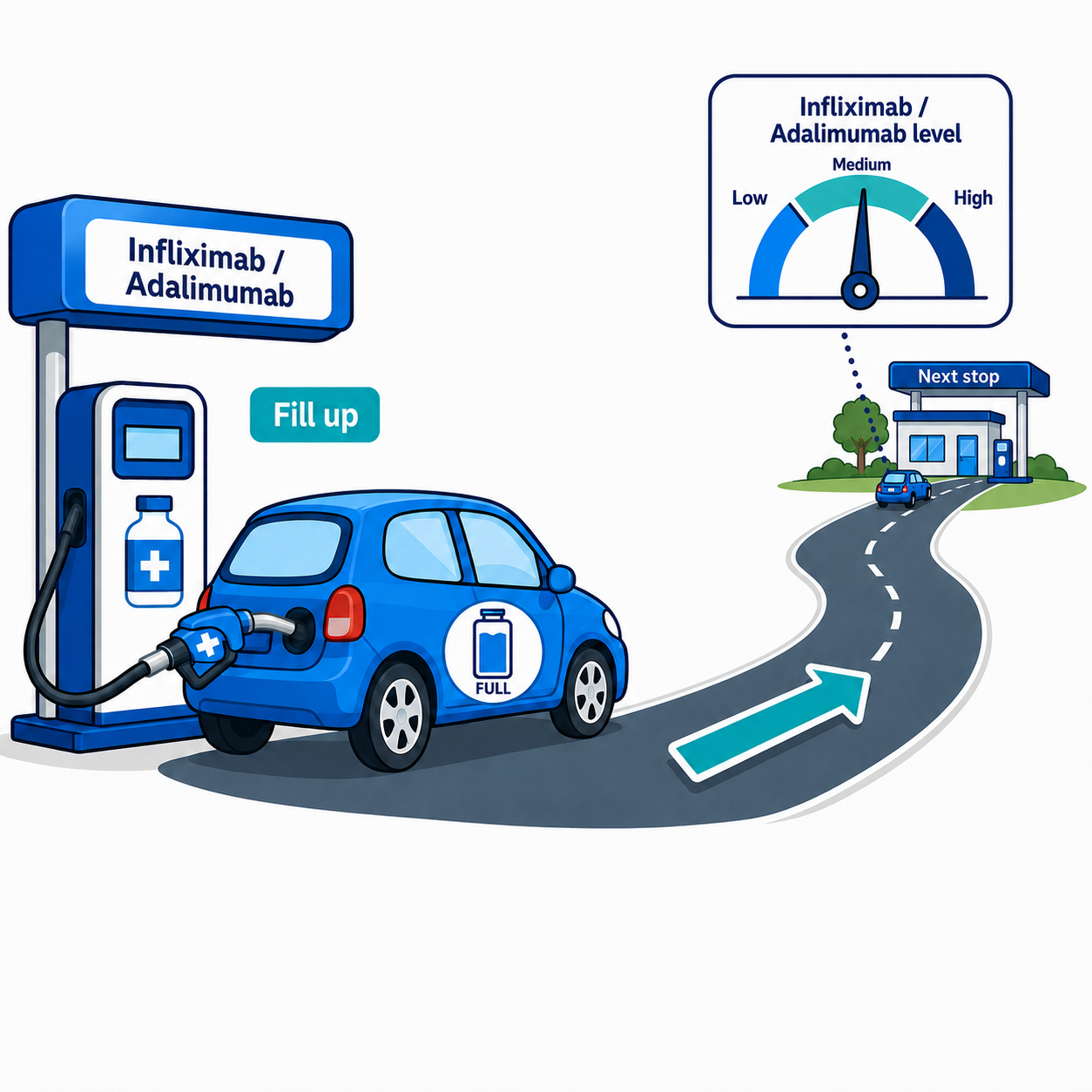
The video uses a tank analogy to explain what happens between one infusion or injection and the next.
What is a trough level?
A trough level is the amount of infliximab or adalimumab left in your blood just before the next infusion or injection.
The aim is to keep enough drug in the body for long enough to control inflammation. If very little remains by the time the next dose is due, the IBD team will want to understand why.
A simple way to think about it
Think of each infusion or injection as filling a tank. The level is highest after treatment and gradually falls as the body clears the drug. The question at the next stop is whether enough medicine remains in the tank.
If the trough is low, the original dose was not necessarily wrong. The body may be clearing or losing the medicine faster than expected.
Why can the trough level be low?
Active inflammation can increase clearance
When inflammation is very active, infliximab or adalimumab may be cleared more quickly. A low trough can therefore occur even when the medicine was given correctly.
Protein and drug can be lost
Severe bowel inflammation can allow protein, and sometimes drug, to be lost through the inflamed bowel. A low albumin may fit this picture. It can be a clue that the body is losing or clearing the biologic more rapidly, although it is not a diagnosis on its own.
Antidrug antibodies can develop
The immune system sometimes recognises infliximab or adalimumab as foreign and makes antibodies against it. These antibodies can increase drug clearance, lower the trough and make treatment less reliable.
What do antibodies mean?
An antibody result is not a simple yes-or-no verdict on the treatment.
The useful questions are whether the antibodies are low or high, whether they persist on repeat testing, and what the drug level is at the same time. Laboratory assays also differ, so a number from one laboratory may not be directly comparable with a number from another.
Low or temporary antibodies may not have the same meaning as high, persistent antibodies accompanied by an undetectable drug level. This is why the antibody result and trough level need to be read together.
Why should the result never be read in isolation?
The same trough level can mean different things in different patients.
Your IBD team will usually ask whether you feel well, whether symptoms have returned before the next dose, and whether objective tests show inflammation. They may look at faecal calprotectin, CRP, albumin, previous treatment response and, when needed, endoscopy or imaging.
For example, symptoms with a therapeutic drug level do not automatically prove that inflammation is active. The symptoms could have another cause. Equally, feeling well does not always guarantee that bowel inflammation is fully controlled.
What might the IBD team consider next?
The result helps the team decide what question to ask next. Depending on the full picture, they may continue the same treatment, adjust the dose or interval, investigate another cause for symptoms, or discuss a different treatment strategy.
Please do not change or delay a dose because of a result you have read on its own. Discuss it with the team looking after your IBD.
My clinical view
When I review these results, I do not begin with “Is the number in range?” I begin with “What problem are we trying to explain?”
If inflammation is controlled and the patient is well, the meaning of a borderline level may be quite different from the same result in someone with rising calprotectin, low albumin and recurrent symptoms. The trough and antibody result are useful because they add another piece to that clinical picture. They do not replace it.

Frequently asked questions
Does a low infliximab or adalimumab level mean the treatment has failed?
No. A low level can occur because of active inflammation, increased clearance, protein and drug loss, or antidrug antibodies. The result needs to be interpreted with symptoms and objective evidence of inflammation.
Do antibodies always mean I must stop the biologic?
No. The meaning depends on the antibody level, whether it persists and how much drug is present at the same time. Your IBD team will use the whole clinical picture to decide what the result means.
When should the blood sample be taken?
A true trough sample is taken immediately before the next scheduled infusion or injection. Timing matters because the drug concentration changes between doses.
Is there one ideal trough level for everybody?
No. The useful level depends on the disease, treatment goal, laboratory assay and clinical situation. Fistulising disease or endoscopic healing may require a higher exposure than symptom control alone.
Important information
This article is for general education and does not replace personal medical advice. Do not stop, delay, increase or change infliximab, adalimumab or another IBD treatment without speaking to your gastroenterologist or IBD team.
Recommended reading
The following pages cover the questions patients commonly ask before starting a biologic, while taking one, and when the response changes.
Drug levels, antibodies and loss of response
- Why a biologic may stop working in IBD
- Why biologics work for some IBD patients but not others
- Why can calprotectin be high when CRP is normal?
Understanding biologics and the available treatment pathways
- Biologics for Crohn's disease and ulcerative colitis
- How biologics work in Crohn's disease and ulcerative colitis
- How doctors choose a biologic for IBD
- Will infliximab work for you?
- Infliximab or vedolizumab for ulcerative colitis?
- IBD treatment update 2026
Infection screening, vaccines and treatment safety
Crohn's disease and ulcerative colitis foundations
If you wish to discuss this further or would like to make an appointment, please use the booking form on this page.