
By Dr Pranab Gyawali, Consultant Gastroenterologist
If you’ve already watched my Iron Deficiency in IBD video (if not—click here to watch it), you’ll know that iron deficiency is by far the most common nutritional issue in Crohn’s and ulcerative colitis. But what if you’ve already corrected your iron and you still feel tired, foggy, or just not yourself?
Well—this is where vitamin B12 and folate come into the picture.
I’m Dr. Pranab, a consultant gastroenterologist in Dubai, and over the past 25 years of looking after IBD patients, I’ve seen this exact situation play out so often.
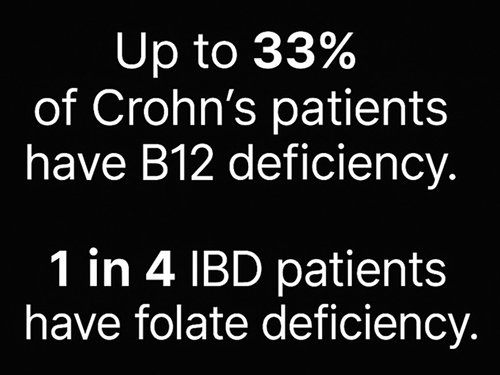
B12 and folate deficiency in inflammatory bowel disease.
Iron’s Not the Only One
Yes, iron deficiency is common—especially during flare-ups and after blood loss. But it’s not the only deficiency I see in clinic.
Many of my Crohn’s and colitis patients are also low in vitamin B12 or folate, and often it goes unnoticed for months—because it’s not always tested.
What does B12 actually do?
Vitamin B12 helps your body make red blood cells, maintain healthy nerves, and support energy and memory.
Without enough of it, you might experience:
- Fatigue and weakness
- Pins and needles
- Memory or concentration issues
- Mood changes
Why are Crohn’s patients at higher risk?
Crohn’s often affects the ileum—the last part of the small bowel, which is exactly where B12 is absorbed.
If the ileum is inflamed, resected, or simply not working well, you’re at real risk of B12 deficiency.
In fact, studies show that up to 33% of Crohn’s disease patients are B12 deficient—compared to just 16% of people with ulcerative colitis.
What about folate?
Folate (also known as folic acid or vitamin B9) is another crucial nutrient that helps with:
- DNA repair
- Red blood cell production
- Supporting gut and immune health
Many IBD patients—especially those taking methotrexate or sulfasa
These medications interfere with folate absorption.
Folate deficiency symptoms can overlap with B12, including:
- Tiredness
- Sore tongue or mouth ulcers
- Low mood
- Poor appetite or hair thinning
What do the guidelines say?
The British Society of Gastroenterology (BSG) 2025 guidelines now recommend screening for B12 and folate in high-risk IBD patients, especially if:
- You’ve had ileal surgery or inflammation
- You’re on certain medications
- You’ve had unexplained fatigue
- You have signs of neuropathy or anemia
In Dubai, we see many patients who haven’t had these checked until they come in with persistent fatigue—even after their iron has improved.
Do you need a multivitamin?
Not necessarily.
In most cases, I prefer targeted testing and personalized treatment—not blanket supplements.
We try to get your nutrients from food first, and correct deficiencies only where needed.
(And yes, vitamin D is the one I do routinely check—even in IBS patients.)
So what’s the takeaway?
If you’re living with IBD in Dubai, and you’re still feeling tired or foggy despite normal iron,
don’t ignore B12 and folate.
They may not be as commonly discussed—but they’re just as important to your recovery and long-term gut health.
- Ask your doctor to check your B12 and folate
- Especially if you have Crohn’s, have had surgery, or take methotrexate
- Don’t guess—test.
Recommended Guides:
FMT, Probiotics and Next-Generation Microbiome Therapies
- AI in Crohn’s and Ulcerative Colitis: Can Machine Learning Predict IBD Treatment Response?
- FMT and infliximab in IBD: could the microbiome help biologics work better?
- Fecal microbiota transplant for Crohn’s disease and ulcerative colitis
- Probiotics for Crohn’s and ulcerative colitis: what actually works?
- Probiotics in ulcerative colitis: what does the MB310 trial mean?
- Engineered probiotic for ulcerative colitis 2026
- Probiotics for ulcerative colitis: what actually works?
Gut Microbiome, Diet and Treatment Response
- Diet and microbiome in IBD: how the right bacteria calm gut inflammation
- Gut microbiome in Crohn’s disease and ulcerative colitis
- How the Oxygen Trap may be driving your IBD, and why diet still matters
- IBD flare risk, diet and calprotectin
- IBD breakthrough: how gut bacteria unlock natural anti-inflammatories
- Gut microbiome test in Dubai
Crohn’s, Colitis and Biologic Treatment Strategy
- Learn about Biologicals used in UC and Crohn’s in Dubai
- Crohn’s disease specialist care in Dubai
- Ulcerative colitis specialist care in Dubai
- How biologics work in Crohn’s and colitis
- How we choose the right biologic for Crohn’s and UC in Dubai
- New omics research: predicting response to biologics in Crohn’s and ulcerative colitis
Investigations and Procedures
- Colonoscopy for Crohn’s and ulcerative colitis monitoring
- Capsule endoscopy for small bowel Crohn’s disease
- MRI abdomen and MR enterography
- CT abdomen and CT enterography
- Hydrogen and methane breath test for SIBO
If you wish to discuss this further or would like to make an appointment, please use the booking form on this page.