
2026 Update from a UK-trained gastroenterologist in Dubai.
I am very interested in diet, gut microbiome research and microbiome-based therapies in inflammatory bowel disease. In my view, this field is unlikely to replace biologics, but it may eventually complement them, support them and possibly help them work better in selected patients.
In this video, I explain why SER-603, a next-generation live biotherapeutic candidate presented at DDW 2026, caught my attention, and why the microbiome pathway belongs on the IBD treatment map.
What is the main message of this video?
The main message is that next generation probiotics in IBD are not the same as ordinary probiotic supplements.
When most people hear the word probiotic, they think of capsules bought from a pharmacy or supermarket. SER-603 is different. It is being developed as a cultivated live biotherapeutic candidate, meaning a designed bacterial consortium selected for specific biological functions.
| Old probiotic thinking | Next generation microbiome therapy |
|---|---|
| Add “good bacteria” | Select bacteria for specific functions |
| Broad and imprecise | Designed and measured |
| May or may not persist | Engraftment and function are studied |
| General gut health claim | Targeted IBD pathway concept |
| Usually not linked to biologics | May be studied alongside biologics |
SER-603 is still early and preclinical. It is not available treatment. But it shows how microbiome therapy is moving from general wellness advice toward more precise IBD medicine.
Why does the microbiome pathway matter in IBD?
In a previous video, I showed an IBD pathway diagram. That diagram included familiar immune pathways such as TNF, IL-23, JAK, integrins, S1P, TL1A and miR-124.
But it also included the microbiome pathway. That was not there by accident.
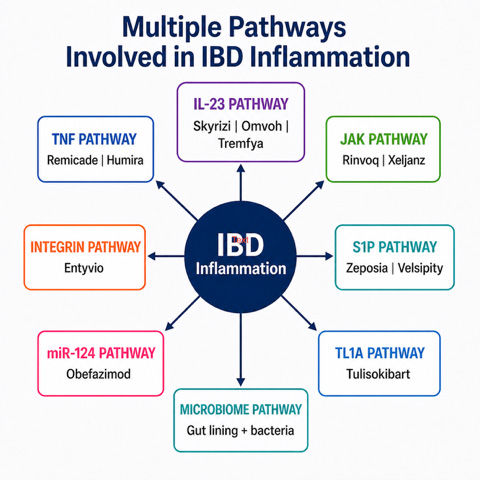
If you have Crohn’s disease or ulcerative colitis, you may already feel that your gut environment affects your symptoms. You may notice changes with diet, fibre, fermented foods, antibiotics, probiotics, stress, sleep or travel.
The problem is that this is often imprecise. You may feel better, but we may not know exactly what changed in your microbiome, which bacterial function improved, whether inflammation actually changed, or whether the same approach would help another patient.
That is why next generation microbiome therapies are interesting. They are trying to target the microbiome pathway in a more controlled and measurable way.
What is SER-603?
SER-603 is a next generation cultivated live biotherapeutic candidate being developed for inflammatory bowel disease.
The SER-603 poster was presented at Digestive Disease Week 2026 and was selected as a DDW Poster of Distinction. The poster was titled The Rational Design of SER-603: A Next Generation Cultivated Microbial Consortia to Treat IBD. Seres described the programme as combining rational strain selection with biomarker-driven patient stratification.
In simpler language:
SER-603 is a designed mixture of bacteria selected for specific jobs in the gut.
| SER-603 design goal | Patient-friendly meaning |
|---|---|
| Reduce microbial inflammatory stimuli | Reduce bacteria or bacterial signals that may drive inflammation |
| Support gut barrier integrity | Help protect the gut lining |
| Deliver useful metabolites | Produce bacterial signals that may influence inflammation |
| Support patient stratification | Identify which patients may be more likely to benefit |
| Potential combination with existing therapies | Possibly work alongside biologics in future trials |
This does not prove that SER-603 works in patients yet. The current data are preclinical.
What did the SER-603 study show?
The SER-603 work showed that a microbiome treatment can be designed using clinical datasets, patient microbiome samples, laboratory testing and prediction tools to target functions relevant to IBD.
The aim was not simply to add “good bacteria.” The aim was to select bacteria that could do specific jobs:
- Reduce inflammatory bacteria and inflammatory signals
- Support the gut barrier
- Produce bacterial metabolites that may help regulate immune cells
- Test performance in patient-derived microbiome models
A simple way to explain it is:
The idea was simple. Choose bacteria that can support the gut barrier, reduce inflammatory signals and influence immune pathways. In the lab model, SER-603 appeared to do that. Now we need patient trials.
Why does Seres Therapeutics matter?
This caught my attention because Seres is not new to microbiome medicines.
Seres Therapeutics developed VOWST, which the FDA approved as the first fecal microbiota product taken orally for the prevention of recurrent Clostridioides difficile infection in adults after antibacterial treatment for recurrent infection.
That does not mean SER-603 will work in IBD. C. difficile and IBD are very different conditions.
But it does mean the company has experience in the microbiome therapeutic space. That makes SER-603 more credible than a generic probiotic story.
A careful way to say this is:
SER-603 comes from Seres, the company behind VOWST, the first FDA-approved oral microbiome therapy for recurrent C. diff. That does not prove SER-603 will work in IBD, but it makes this programme worth watching.
Is SER-603 a probiotic?
SER-603 is not best thought of as a standard probiotic.
A better term is live biotherapeutic product.
| Ordinary probiotic | SER-603 style live biotherapeutic |
|---|---|
| Usually sold as a supplement | Developed as a medical therapy candidate |
| Often broad gut health claims | Designed for specific IBD-relevant functions |
| Usually not patient-selected | May use biomarkers to identify likely responders |
| Often not tested with biologic strategy | May be studied alone and alongside existing therapies |
| Not designed around IBD pathways | Designed around microbiome and immune interactions |
So the practical message is:
This is not about taking random probiotics. It is about designing bacterial therapy to target a pathway.
Could next generation probiotics replace biologics?
In my view, no.
At least not for most patients with moderate or severe Crohn’s disease or ulcerative colitis.
Biologics remain central because they block key inflammatory pathways such as TNF, IL-23 and integrin trafficking. My view is that next generation microbiome therapies are more likely to support biologics, not replace them.
| Biologics | Microbiome therapy |
|---|---|
| Block immune inflammation | May change the gut environment feeding inflammation |
| Target immune pathways | Target bacteria, metabolites and gut barrier function |
| Used for moderate to severe disease | May eventually support selected patient groups |
| Proven in clinical trials | SER-603 still needs patient trials |
The future may not be biologics versus microbiome therapy. It may be biologics plus microbiome pathway support in selected patients.
Could microbiome therapy make biologics work better?
This is one of the most interesting questions.
Seres has described SER-603 as a programme with mechanisms that may be complementary to existing therapeutics, with potential opportunity for both monotherapy and combination therapy. This remains early and needs clinical testing.
That combination question is what interests me most.
We already know that diet and microbiome factors may influence the inflammatory environment in IBD. If microbiome therapy can make the gut environment less inflammatory, it may one day help biologics work more effectively, or help maintain remission more reliably.
But this remains a hypothesis. We need clinical trials.
Is SER-603 available for Crohn’s or ulcerative colitis patients now?
No.
SER-603 is not available as a treatment for Crohn’s disease or ulcerative colitis. The current data are preclinical. That means the evidence comes from laboratory and translational models, not from completed patient treatment trials.
If you have IBD, you should not stop biologics, immunomodulators, 5-ASA, steroids or other prescribed treatments because of microbiome research.
The correct takeaway is:
SER-603 is not a treatment you can request today. It is an early signal of where IBD microbiome therapy may be heading.
What should patients take away?
The main takeaway is that the microbiome is becoming a serious part of IBD treatment research.
This does not mean ordinary probiotics treat IBD. It does not mean you should replace medication with supplements.
It means researchers are now trying to design microbiome therapies more precisely:
- Choosing bacteria for specific jobs
- Targeting gut barrier function
- Reducing inflammatory signals
- Looking for biomarkers to select the right patients
- Testing whether microbiome therapies could work alone or alongside biologics
That is why I included microbiome on my IBD pathway map.
It is not background noise. It may become another treatment layer in precision IBD care.
Frequently Asked Questions
Are next generation probiotics the same as ordinary probiotics?
No. Next generation probiotics, or live biotherapeutic products, are designed and studied more like medical treatments. They are selected for specific functions, such as supporting the gut barrier or influencing inflammatory signals.
What is SER-603?
SER-603 is a next generation cultivated live biotherapeutic candidate being developed for inflammatory bowel disease. It is a designed bacterial consortium intended to target microbiome functions linked to gut barrier integrity, mucosal healing and inflammation.
Is SER-603 proven to treat Crohn’s disease or ulcerative colitis?
No. SER-603 is still early and preclinical. It has not yet been proven in human IBD treatment trials.
Why is SER-603 interesting?
SER-603 is interesting because it is not a generic probiotic. It is designed to target specific microbiome functions and may eventually be studied alone or alongside existing IBD therapies, including biologics.
Could microbiome therapy replace biologics?
For most patients, this is unlikely. The more realistic future is that microbiome therapy may support biologics by making the gut environment less inflammatory.
Could microbiome therapy support biologic treatment?
Possibly, but this needs to be proven. The future question is whether microbiome therapy can make the gut environment less inflammatory and therefore support immune-pathway treatments such as biologics.
Why does Seres Therapeutics matter?
Seres developed VOWST, the first FDA-approved oral microbiome therapy for recurrent C. difficile infection. This gives the company credibility in microbiome therapeutics, although SER-603 still needs IBD clinical trial data.
Should I take probiotics if I have IBD?
Do not assume that ordinary probiotics will control Crohn’s disease or ulcerative colitis. Some may help selected patients with symptoms, but IBD treatment decisions should be based on disease activity, inflammatory markers, endoscopy, imaging and specialist review.
What is the microbiome pathway in IBD?
The microbiome pathway refers to the interaction between gut bacteria, bacterial metabolites, the gut barrier and immune signalling. These interactions may influence inflammation in Crohn’s disease and ulcerative colitis.
Recommended Guides:
FMT, Probiotics and Next-Generation Microbiome Therapies
- Are probiotics automatically good for gut health?
- The new miR-124 treatment pathway
- AI in Crohn’s and Ulcerative Colitis: Can Machine Learning Predict IBD Treatment Response?
- FMT and infliximab in IBD: could the microbiome help biologics work better?
- Fecal microbiota transplant for Crohn’s disease and ulcerative colitis
- Probiotics for Crohn’s and ulcerative colitis: what actually works?
- Probiotics in ulcerative colitis: what does the MB310 trial mean?
- Engineered probiotic for ulcerative colitis 2026
- Probiotics for ulcerative colitis: what actually works?
Gut Microbiome, Diet and Treatment Response
- Diet and microbiome in IBD: how the right bacteria calm gut inflammation
- Gut microbiome in Crohn’s disease and ulcerative colitis
- How the Oxygen Trap may be driving your IBD, and why diet still matters
- IBD flare risk, diet and calprotectin
- IBD breakthrough: how gut bacteria unlock natural anti-inflammatories
- Gut microbiome test in Dubai
Crohn’s, Colitis and Biologic Treatment Strategy
- Learn about Biologicals used in UC and Crohn’s in Dubai
- Crohn’s disease specialist care in Dubai
- Ulcerative colitis specialist care in Dubai
- How biologics work in Crohn’s and colitis
- How we choose the right biologic for Crohn’s and UC in Dubai
- New omics research: predicting response to biologics in Crohn’s and ulcerative colitis
Investigations and Procedures
- Colonoscopy for Crohn’s and ulcerative colitis monitoring
- Capsule endoscopy for small bowel Crohn’s disease
- MRI abdomen and MR enterography
- CT abdomen and CT enterography
- Hydrogen and methane breath test for SIBO
If you wish to discuss this further or would like to make an appointment, please use the booking form on this page.