
Watch my explanation
In this short video, I explain why the miR-124 pathway is different from familiar TNF, IL-23, integrin and JAK pathways, and why the maintenance results have made me take this medicine seriously while remaining cautious about longer-term safety.
2026 Update from a UK-trained gastroenterologist in Dubai.
Obefazimod is an investigational once-daily oral medicine that works through a less familiar inflammatory mechanism. This guide explains what miR-124 is, what the Phase 3 maintenance trial reported, the safety questions still being assessed and when an FDA decision might become possible.
The short answer
Obefazimod is not a biologic and it is not yet approved. It is an investigational oral small molecule that enhances expression of microRNA-124, or miR-124, a regulatory RNA involved in controlling several inflammatory signals. In the Phase 3 ABTECT maintenance trial, approximately 51% of initial responders were in clinical remission after 44 weeks of maintenance treatment, compared with approximately 10% receiving placebo. The company plans an FDA submission in late 2026.
Obefazimod at a glance
- What it is
- An investigational once-daily oral small molecule, previously called ABX464.
- Condition studied
- Moderately to severely active ulcerative colitis.
- Main mechanism
- Enhances expression of miR-124, a small regulatory RNA involved in inflammatory control.
- Current stage
- Phase 3 maintenance results reported. Not approved.
- FDA timing
- Submission planned for late 2026. A decision during 2027 is possible but not guaranteed.
Why does the miR-124 pathway matter?
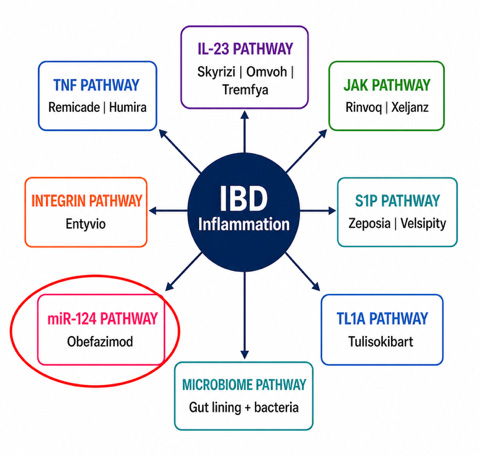
Ulcerative colitis is not driven by one identical inflammatory pathway in every patient. Current treatments may target TNF, IL-23, integrins, JAK signalling or S1P receptors. Other research is exploring TL1A, the microbiome and miR-124.
One patient may respond very well to one mechanism while another patient with the same diagnosis may need a different approach. We still do not have one routine validated test that can identify the dominant inflammatory pathway in every individual patient.
That is why miR-124 is worth understanding. Obefazimod is not simply another medicine blocking TNF or IL-23. It is designed to enhance a regulatory RNA that may influence several inflammatory signals.
For the wider treatment-selection problem, read why biologics work for some Crohn’s and colitis patients but not others.
What is microRNA-124?
MicroRNA-124, usually shortened to miR-124, is a small regulatory RNA produced inside cells. It is not a protein, antibody, hormone or cytokine.
Genes contain instructions that cells use to make proteins. MicroRNAs help regulate how strongly some of those instructions are translated. In inflammatory conditions, miR-124 is associated with reduced production of several inflammatory mediators.
A simple patient-friendly description is that miR-124 forms part of the body’s natural system for turning down excessive inflammation. This is an analogy rather than a complete account of the molecular biology.
How does obefazimod work?
Obefazimod does not contain miR-124 and does not supply it directly. It enhances the cellular expression of miR-124.
Earlier clinical research demonstrated increased miR-124 expression in blood and rectal tissue. Phase 3 mechanistic analyses have also reported increased miR-124 in blood and colon tissue, together with changes in selected inflammatory cytokines.
The proposed effect is therefore broader than directly blocking one cytokine. However, a broader mechanism should not automatically be interpreted as greater effectiveness or greater safety. Those questions require comparative trials and longer follow-up.
What is obefazimod?
Obefazimod, previously known as ABX464, is an investigational once-daily oral small molecule being developed for moderately to severely active ulcerative colitis.
It is not a biologic. Biologics are large protein medicines, usually antibodies, that are given by injection or infusion and target a particular molecule or receptor. Obefazimod is taken orally and works through regulation of miR-124 expression.
What did the Phase 3 maintenance trial study?
The global Phase 3 ABTECT maintenance trial included 580 adults with moderately to severely active ulcerative colitis who had already shown a clinical response during one of the eight-week induction trials.
Those induction responders were re-randomised to receive obefazimod 25 mg once daily, obefazimod 50 mg once daily or placebo for a further 44 weeks.
What were the main Phase 3 results?
At week 44 of maintenance treatment:
- Clinical remission: 50.8% with 25 mg and 51.3% with 50 mg, compared with 10.4% with placebo.
- Endoscopic remission: 41.5% with 25 mg and 47.7% with 50 mg, compared with 9.9% with placebo.
- Steroid-free clinical remission: 45.1% with 25 mg and 47.7% with 50 mg, compared with 9.9% with placebo.
| Outcome at week 44 | Placebo | Obefazimod 25 mg | Obefazimod 50 mg |
|---|---|---|---|
| Clinical remission | 10.4% | 50.8% | 51.3% |
| Endoscopic remission | 9.9% | 41.5% | 47.7% |
| Steroid-free clinical remission | 9.9% | 45.1% | 47.7% |
What do these results mean for patients?
The findings indicate that, among patients who responded initially, continuing obefazimod was associated with substantially higher rates of clinical remission, steroid-free remission and complete endoscopic remission than switching to placebo.
For me, the important feature is the combination of a genuinely different oral mechanism with clinically meaningful and objective outcomes. This is more relevant than a study reporting symptom improvement alone.
It is still not possible to say where obefazimod will sit in the treatment sequence. The trial did not compare it directly with upadacitinib, ozanimod, etrasimod, vedolizumab, anti-TNF therapy or an IL-23 treatment.
What do we know about safety?
The company described the overall maintenance safety findings as favourable, and no deaths were reported. Nevertheless, the longer-term safety profile cannot yet be regarded as settled.
Some cancer-related events were reported in the higher-dose group. The investigators did not think the treatment caused them, but I will be very interested to see how the FDA interprets this and whether it asks for longer follow-up.
A small number of varied events does not establish that the medicine caused cancer. Equally, a company press release cannot resolve a potential safety question. Regulators will review the individual cases, background risks, timing, dose, total exposure and the wider safety database.
Is obefazimod approved, and when might it become available?
Obefazimod is not currently approved for ulcerative colitis and cannot be prescribed as an approved treatment.
Abivax plans to submit a New Drug Application to the United States FDA in late 2026. If the application is submitted and accepted for review, an FDA decision during 2027 is possible. Approval is not guaranteed, and the FDA may request additional information or follow-up.
A United States decision would not automatically make the medicine available in the United Kingdom, Europe, the UAE or other regions. Each jurisdiction would require its own regulatory and access process.
Is obefazimod also being studied in Crohn’s disease?
Yes, but the most advanced efficacy results currently relate to ulcerative colitis. A separate Crohn’s disease development programme is under way, and conclusions about Crohn’s disease should wait for those data.
How does obefazimod compare with existing oral UC treatments?
We do not yet know. Cross-trial comparisons are unreliable because trials differ in patient selection, previous treatment exposure, endpoint definitions, induction response requirements and statistical methods.
The ABTECT results show that obefazimod was superior to placebo in its own maintenance trial. They do not show that it is better than another advanced therapy.
For information about an approved oral option, read Rinvoq for Crohn’s disease and ulcerative colitis. For another investigational oral pathway, read icotrokinra and oral IL-23 treatment research.
My current view
I am encouraged by the efficacy results because miR-124 is a genuinely different mechanism and the programme has now reached pivotal Phase 3 maintenance data. That makes it more than an interesting laboratory idea.
I would not call it a breakthrough, a game changer or the best treatment. It is not approved, it has not been tested head to head against the main advanced therapies and the longer-term safety assessment remains incomplete.
For patients with ulcerative colitis, the sensible position is hopeful but measured. I will be tracking the FDA review, longer follow-up and, if approved, the real-world evidence that eventually tells us where this medicine truly fits.
Primary sources and further reading
Frequently asked questions
Is obefazimod a biologic?
No. Obefazimod is an investigational oral small molecule. It increases the expression of microRNA-124 rather than acting as a biological antibody treatment.
Is obefazimod approved for ulcerative colitis?
No. Obefazimod remains investigational and cannot currently be prescribed as an approved treatment for ulcerative colitis.
What is miR-124?
MiR-124 is a small regulatory RNA produced inside cells. It helps regulate the production of several inflammatory signals.
How is the miR-124 pathway different from TNF or IL-23?
TNF and IL-23 treatments block specific inflammatory targets. Obefazimod enhances expression of miR-124, a regulatory RNA associated with reduction of several inflammatory signals.
Can doctors test whether miR-124 is driving my ulcerative colitis?
Not at present. There is no routine validated test that can show whether the miR-124 pathway is the dominant inflammatory pathway in an individual patient.
Did half of all patients starting obefazimod enter remission?
No. The approximately 51% maintenance remission result applied to patients who had already responded during the first eight weeks of treatment.
Did obefazimod produce healing during colonoscopy?
Endoscopic remission was reported in approximately 42% to 48% of patients continuing obefazimod, compared with approximately 10% receiving placebo.
Were cancer-related events reported during the trial?
Some cancer-related events were reported in the higher-dose group. Investigators did not consider them treatment related, but the FDA assessment and longer-term follow-up will be important.
When could obefazimod be approved?
An FDA application is planned for late 2026. A decision may be possible during 2027, but approval and timing are not guaranteed.
Should I wait for obefazimod before starting another ulcerative colitis treatment?
No. Obefazimod is not approved and there is no confirmed availability date. Treatment decisions should be based on established options available now and discussed with your own gastroenterology team.
Important information
This page is for education only. It does not diagnose ulcerative colitis, recommend obefazimod or replace advice from your own gastroenterology team. Obefazimod remains investigational and is not currently an approved treatment.
Last updated: 23 June 2026