
By Dr. Pranab Gyawali — Consultant Gastroenterologist, Dubai, UAE.
I’m a UK-trained gastroenterologist in Dubai, and I’ve looked after IBD and gut health problems for over 25 years.
This article follows my short video (1 min 49 sec) after a patient with ulcerative colitis messaged me a very practical observation: while taking Rinvoq (upadacitinib), they noticed worsening symptoms during a period of high sucralose intake (mainly via flavoured water / shakes), then felt dramatically better after stopping sucralose.
Important: this is not proof, and it is not advice to stop medication. IBD triggers are often individual. The goal is to help you think clearly and safely about potential triggers alongside effective medical treatment.
Watch the VLOG
Quick patient example (real-world trigger tracking)
The patient described symptoms consistent with an IBD flare pattern (urgency, frequency, pain, blood/mucus). The key detail was timing: symptoms worsened after introducing ~2L/day of flavoured water sweetened with sucralose, then improved steadily after removing it. They also noted sucralose-containing protein shakes in the months before their original diagnosis.
Can sucralose trigger ulcerative colitis or Crohn’s flares?
We do not have proof that sucralose is a universal IBD trigger. However, we do know that IBD is shaped by a combination of immune dysregulation, the gut microbiome, and environmental exposures. Diet-related exposures can influence the microbiome and gut barrier in some individuals. That is why personalised trigger identification can be clinically meaningful.
What is sucralose?
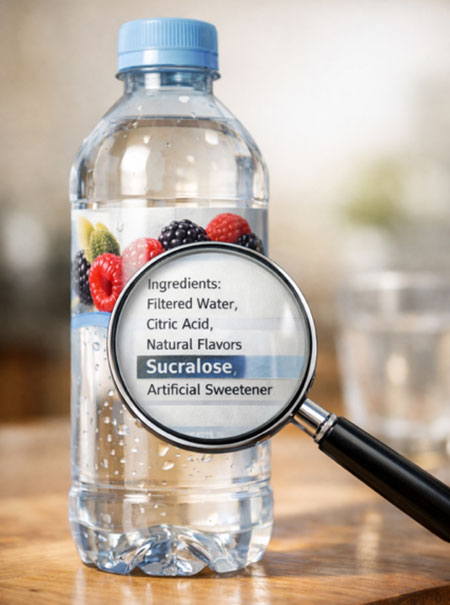
Sucralose is a high-intensity artificial sweetener used to sweeten foods and drinks without adding sugar. It is commonly used in “zero sugar” or “diet” products.
Where is sucralose found (common Dubai grocery examples)?
In practice, sucralose often appears in:
- Flavoured waters
- Zero-sugar soft drinks
- Protein shakes / ready-to-drink fitness beverages
- “Sugar-free” desserts and snacks
Why “one trigger for everyone” is unlikely in IBD
IBD is not caused by a single factor. Two people can have the same diagnosis, the same medication class, and very different flare patterns. For some, stress is the dominant trigger; for others it may be sleep disruption, infections, certain food patterns, or specific additives. The practical takeaway is: look for your trigger, not “the trigger.”
If I feel better after removing a trigger, can I stop my medication?
No. Feeling better is encouraging, but symptoms do not always reflect inflammation. Any treatment decisions—especially with moderate-to-severe UC or Crohn’s—should be made with your treating gastroenterologist and supported by monitoring (blood markers, stool tests such as calprotectin, and endoscopy/imaging when appropriate).
How to identify your personal IBD triggers safely (simple method)
- Pick one suspected trigger (example: sucralose-containing flavoured water).
- Remove it for 2–3 weeks while keeping everything else stable where possible.
- Track symptoms (urgency, frequency, pain, blood, sleep, stress) in a simple daily note.
- Escalate early if you have bleeding, fevers, weight loss, dehydration, or worsening pain.
- Discuss with your IBD team before re-challenging or changing medication.
Frequently Asked Questions
Can sucralose trigger ulcerative colitis or Crohn’s flares?
We do not have proof that sucralose universally triggers IBD flares. Some patients report symptom worsening with certain additives or sweeteners. Treat this as an individual trigger hypothesis and discuss changes with your IBD team.
What is sucralose and where is it found?
Sucralose is a high-intensity artificial sweetener used in many “zero sugar” products—commonly flavoured waters, diet soft drinks, and protein shakes.
Why might sweeteners matter in IBD?
IBD is influenced by immune activity, the microbiome, and environmental factors. Diet-related exposures can affect the microbiome and gut barrier in some individuals, supporting the concept of personal triggers.
If I feel better after removing a trigger, can I stop my medication?
No. Medication changes should only be made with your treating team and appropriate monitoring, because symptoms do not always reflect inflammation.
How do I identify my personal IBD triggers safely?
Remove one suspected trigger for 2–3 weeks, track symptoms consistently, and involve your IBD team—especially if there is bleeding, weight loss, fever, or worsening pain.
Recommended Guides
- Learn about Biologicals used in UC and Crohn’s in Dubai
- Crohn’s Disease — Dubai
- Ulcerative Colitis — Dubai
- Gut Microbiome in Crohn’s & Ulcerative Colitis
- Diarrhoea — causes & red flags
Related Gut Health VLOGs
- Rinvoq for Crohn’s & Ulcerative Colitis in Dubai
- How Biologics Work in Crohn’s and Colitis
- IBD Treatment Update 2026
- Deep remission: “Feeling fine isn’t enough”
- Stress & the gut–brain axis in IBD
- SIBO in Crohn’s & UC
- B12 and Folate deficiency in Crohn’s & UC
- Iron deficiency & anaemia in Crohn’s & UC
- Iron-rich foods in Crohn’s & colitis
- Candida in Crohn’s & colitis
- IBD breakthrough: natural anti-inflammatories
Investigations & Procedures
- Hydrogen & Methane Breath Test (SIBO)
- Capsule Endoscopy (Small Bowel Imaging)
- MRI Abdomen / MR Enterography
- Colonoscopy
- Gastroscopy / Upper GI Endoscopy
- CT Abdomen and Pelvis
- Ultrasound Abdomen
- Urea Breath Test
- Fecal H. pylori Antigen Test
- Diagnostic Tests for GI Disorders
If you wish to discuss this further or would like to make an appointment, please use the booking form on this page. A member of our team will contact you within 12 business hours.