
2026 Update from a UK-trained gastroenterologist in Dubai.
Introduction
One of my followers recently asked whether smartwatches and wearable devices can help monitor Crohn’s disease and ulcerative colitis.
Thank you for raising this, because there has been a lot of talk about smartwatches, AI and IBD flare prediction. It was a useful time to review what is actually happening in this area.
I’m Dr Pranab, consultant gastroenterologist in Dubai, trained in the UK, with over 25 years experience looking after patients with Crohn’s disease, ulcerative colitis and inflammatory bowel disease.
My view is cautious but interested.
Smartwatches cannot reliably predict IBD flares today. But the early signals are real enough to take seriously.
Video
Can a smartwatch predict an IBD flare?
Not reliably in day to day clinical practice yet.
But this is no longer just science fiction.
The key study I would mention is the Mount Sinai IBD Forecast study, published in Gastroenterology in 2025.
For people who want to read the original study, here it is: Physiological Data Collected From Wearable Devices Identify and Predict Inflammatory Bowel Disease Flares.
This study included 309 adults with Crohn’s disease or ulcerative colitis across 36 US states.
People used consumer wearable devices including Apple Watch, Fitbit and Oura Ring.
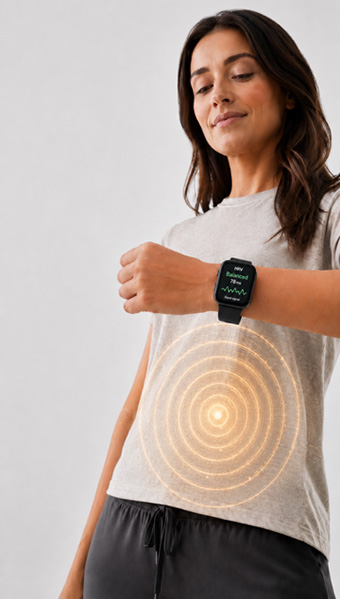
The researchers looked at signals such as:
- Heart rate variability
- Heart rate
- Resting heart rate
- Step count
- Oxygenation
The main finding was that there was a signal.
Heart rate and resting heart rate were higher around inflammatory and symptomatic flares.
Heart rate variability patterns changed.
Steps were lower around inflammatory activity.
Some of these changes appeared weeks before the flare became obvious.
That is interesting because it suggests the body may show physiological stress before symptoms fully declare themselves.
What is heart rate variability and why does it matter in IBD?
Heart rate variability, often shortened to HRV, is a measure of the variation in timing between heartbeats.
Many people who wear smartwatches or fitness trackers already look at HRV.
In simple terms, HRV can reflect how the autonomic nervous system is behaving.
Inflammation can affect the body beyond the bowel. It can affect sleep, fatigue, heart rate, resting heart rate, activity levels and autonomic tone.
That is why HRV in IBD is interesting.
But this is also where we must be careful.
A low HRV does not mean a Crohn’s flare.
A high resting heart rate does not mean ulcerative colitis activity.
These signals are not specific to IBD.
What else can change HRV and resting heart rate?
| Possible cause | Why it matters |
|---|---|
| Poor sleep | Can lower HRV and raise resting heart rate |
| Stress | Can affect autonomic tone and heart rate patterns |
| Viral infection | Can raise resting heart rate and disturb sleep |
| Alcohol | Can reduce HRV and worsen sleep quality |
| Dehydration | Can increase heart rate |
| Travel | Can disturb sleep, routine and recovery |
| Exercise or overtraining | Can temporarily lower HRV |
| Pain | Can raise physiological stress signals |
| Anxiety | Can increase heart rate and affect HRV |
| Fasting | Can affect hydration, sleep and energy |
| Medication changes | Can alter heart rate, sleep or activity |
| Menstrual cycle changes | Can affect resting heart rate and HRV |
So the smartwatch may be detecting body stress, not bowel inflammation directly.
That is the key distinction.
Is fecal calprotectin still better than a smartwatch?
Yes.
Fecal calprotectin is still much closer to bowel inflammation.
It is not perfect, but it is far more directly connected to gut inflammation than a smartwatch signal.
Importantly, fecal calprotectin can rise months before a clinical flare becomes obvious. This is why it is already used in Crohn’s disease monitoring and ulcerative colitis monitoring.
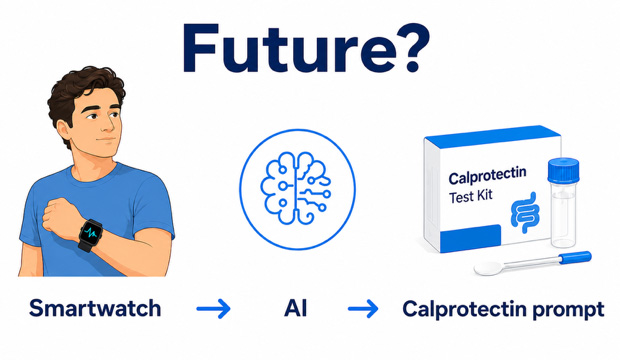
So I do not think the future is:
Smartwatch replaces calprotectin.
I think the more realistic future is:
Smartwatch plus AI detects a repeated pattern, then prompts a calprotectin test when you were not planning to do one.
That would still be a major change.
Where does AI fit into this?
No doctor can manually interpret thousands of data points from heart rate, HRV, sleep, activity and oxygenation every week.
That is where AI may matter.
The future of IBD flare prediction is unlikely to be one magic number.
It is more likely to involve combining several signals:
- Symptoms
- Fecal calprotectin
- Blood tests such as CRP
- Drug levels
- Treatment history
- Microbiome data
- Metabolomic data
- Wearable data from smartwatches or fitness trackers
AI may help identify patterns that are too subtle for a patient or clinician to detect manually.
That links with the broader direction of precision IBD care, where machine learning is already being studied to predict treatment response in Crohn’s disease and ulcerative colitis.
My view
Smartwatches cannot reliably predict IBD flares today.
But the early signals are real and the future looks interesting.
For now, fecal calprotectin remains much closer to bowel inflammation.
In the future, AI may monitor smartwatch patterns over weeks and prompt a calprotectin test in a patient who feels well and was not expecting to check.
That is the useful possibility.
Frequently asked questions
Can a smartwatch predict an IBD flare?
Not reliably in day to day clinical practice today. Research suggests that wearable signals such as HRV, resting heart rate, steps and oxygenation may change around Crohn’s disease and ulcerative colitis flares, but these signals are not specific to bowel inflammation.
What wearable signals are being studied in Crohn’s and ulcerative colitis?
The main signals being studied include heart rate variability, heart rate, resting heart rate, step count, oxygenation, sleep and activity patterns.
Does a low HRV mean I am having a Crohn’s or colitis flare?
No. Low HRV can occur with inflammation, but it can also be affected by poor sleep, stress, infection, alcohol, dehydration, travel, exercise, pain, anxiety, fasting, medication changes and menstrual cycle changes.
Is fecal calprotectin still useful if I use a smartwatch?
Yes. Fecal calprotectin remains much closer to bowel inflammation than a smartwatch signal. A possible future role for smartwatches is that AI may recognise repeated patterns and prompt calprotectin testing earlier.
Recommended VLOGs and guides
Precision IBD and flare prediction
- Why is my calprotectin high but my CRP normal?
- AI and Crohn’s Disease: Can Machine Learning Predict Response to Enteral Nutrition?
- Why Biologics Work for Some IBD Patients But Not Others
- Predicting Biologic Treatment Success in Crohn’s and Ulcerative Colitis
- Tulisokibart and Biomarker Based Prediction in IBD
- Granzyme A Stool Testing and the Future of IBD Monitoring
Crohn’s disease and ulcerative colitis flare monitoring
Biologics, treatment response and precision medicine
- Learn about Biologicals used in UC and Crohn’s in Dubai
- How Biologics Work in Crohn’s and Ulcerative Colitis
- Stelara vs Skyrizi in Crohn’s Disease
- Crohn’s Treatment Updates
- Ulcerative Colitis Treatment Updates
Diet, microbiome and flare related monitoring
- Gut Microbiome in Crohn’s and Ulcerative Colitis
- Next Generation Probiotics in Crohn’s and Ulcerative Colitis
- FMT and Microbiome Therapies in IBD
- Elemental Diet and Enteral Nutrition in Crohn’s Disease
- Ultra Processed Foods and the Gut Microbiome
Symptoms that may overlap with flares
If you wish to discuss this further or would like to make an appointment, please use the booking form on this page.