
Watch the video
In this short video, I explain these five mistakes and what to consider instead. You can watch the video below or continue reading.
- Cutting out several foods at once
- Assuming every symptom after eating means more inflammation
- Cutting out fibre and staying low fibre
- Copying someone else’s Crohn’s diet
- Searching for one special Crohn’s diet
Written and medically reviewed by Dr Pranab Gyawali, UK trained Consultant Gastroenterologist
Published:
What are the five common Crohn’s nutrition mistakes?
Five common mistakes are cutting out several foods at once, assuming every symptom after eating means more inflammation, staying on a low fibre diet when it is no longer needed, copying another person’s diet and searching for one special Crohn’s diet that works for everyone.
Diet needs to take account of active inflammation, strictures, previous surgery, symptoms, food tolerance and nutritional needs. The aim is the broadest, safest and most nutritious diet that works for you at that stage of your Crohn’s disease.
I am a UK trained Consultant Gastroenterologist and have looked after people with Crohn’s disease and ulcerative colitis for more than 25 years.
During that time, I have seen many people become frightened of food. This is understandable. If eating is followed by pain, bloating or diarrhoea, avoiding that food can feel like the safest thing to do.
The problem is that more and more foods may gradually be removed. The diet becomes very limited, but the person may still not know which food is causing symptoms or whether the Crohn’s inflammation is actually worse.
Here are five of the most common Crohn’s nutrition mistakes I see in clinical practice.
Mistake 1: Cutting out several foods at once
If you remove several foods at the same time, it becomes difficult to know which change helped.
You may end up avoiding foods that were not causing a problem. Over time, a very restricted diet can leave you short of calories, protein, vitamins and minerals.
A 2024 survey of adults with Crohn’s disease found that 42% of 160 people were following some form of exclusion diet. This shows how common food restriction has become.
Try to make one major change at a time. Keep a simple record of what you ate, your symptoms and what was happening with your Crohn’s at the time. If you remove a complete food group, ask how and when it should be reviewed.
Mistake 2: Assuming symptoms after eating mean inflammation
A food can cause bloating, pain, diarrhoea or urgency without making Crohn’s inflammation worse.
This does not mean the symptoms are unimportant. It means we need to understand why they are happening.
Possible reasons include active Crohn’s disease, a narrowing in the bowel, previous surgery, lactose intolerance, bile acid diarrhoea or irritable bowel type symptoms alongside Crohn’s disease.
Symptoms alone cannot reliably tell us whether inflammation is controlled. Depending on the situation, tests such as faecal calprotectin, CRP, intestinal ultrasound, MRI or endoscopy may help.
Food can affect inflammation in some circumstances, and structured dietary treatments can help selected people with Crohn’s disease. But a symptom after one meal does not prove that the bowel has become more inflamed.
You can read more about diet, calprotectin and the risk of a flare.
Mistake 3: Cutting out fibre and staying low fibre
A low fibre diet may be appropriate during some flares or if you have a stricture. But it should not automatically become your permanent diet.
A study of 434 people with inflammatory bowel disease found that 37% partly or completely avoided fibre. This included people with Crohn’s disease and ulcerative colitis.

Some people tolerate fibre better when food is peeled, cooked, chopped or blended. A soft cooked vegetable may be easier to manage than a raw vegetable with a tough skin.
The aim is not to tell everyone with Crohn’s to eat more fibre. It is to check whether avoiding fibre is still necessary and whether safer forms can be introduced.
Mistake 4: Copying someone else’s Crohn’s diet
Another patient’s experience can be helpful, but their Crohn’s disease may be very different from yours.
Their inflammation may affect a different part of the bowel. They may have had surgery or have a stricture. Their medicines, nutritional needs and food tolerance may also be different.
This matters when restrictive diets such as carnivore or ketogenic diets are promoted online. Someone may report fewer symptoms, but that does not mean the same diet will suit you. It also does not prove that their bowel inflammation is controlled.
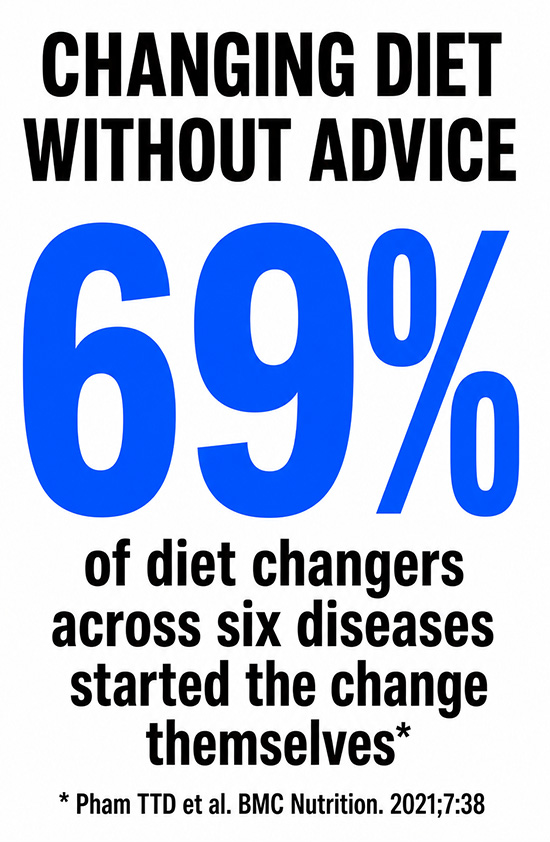
In a survey across six immune related diseases, 69% of the people who had changed their diet said that they had started the change themselves. It did not show that 69% of people with Crohn’s followed internet advice.
Together, you can decide what the diet is meant to achieve, whether it is safe for your situation and how you will know if it is working.
My article on carnivore and ketogenic diets in Crohn’s disease and ulcerative colitis explains this in more detail.
Mistake 5: Searching for one special Crohn’s diet
There is no single Crohn’s diet that works for everyone.
The right diet depends on where the inflammation is, whether it is active, whether you have a stricture, previous surgery, your medicines, your nutritional health and which foods you tolerate.
Daily life matters too. A diet needs to work with your culture, budget, work and family life.
This does not mean diet cannot help treat Crohn’s disease. Exclusive enteral nutrition and other structured dietary treatments can help selected patients. They need proper supervision and should not be confused with a universal food list from the internet.
A more restrictive diet is not automatically a better diet. The goal is to find the broadest range of foods that is safe, comfortable and nutritious for you.
For a wider guide, read what can I eat if I have IBD?
What should you do instead?
Start by involving your gastroenterologist and an IBD dietitian. Crohn’s nutrition works best as a team decision because the right advice depends on your disease and your nutritional needs.
Then make one major change at a time. Keep a simple record. Do not assume that symptoms always show what the inflammation is doing.
Review restrictions rather than allowing them to continue indefinitely. Ask for help if you are losing weight, becoming frightened of eating or finding that your list of safe foods is getting smaller.
When should you seek medical advice quickly?
Seek prompt medical assessment if you have repeated vomiting, increasing abdominal swelling, severe gripping pain, an inability to pass stool or wind, rapid weight loss, or difficulty keeping food and fluids down.
These symptoms need medical assessment. Do not try to manage them by removing more foods on your own.
My view
After more than 25 years caring for people with Crohn’s disease and ulcerative colitis, I have seen that food restriction usually begins for a good reason. People are trying to reduce symptoms and regain control.
My concern is when the diet becomes narrower without a clear plan or without checking what the inflammation is doing. The best approach is individual. It should consider symptoms, inflammation, strictures and nutrition together.
There is no universal Crohn’s diet. The goal is the broadest, safest and most nutritious diet that works for you at that stage of your disease.
See future updates from Dr Pranab on Google
For more Crohn's disease updates from Dr Pranab, you can choose Gut Health Dubai as a Preferred Source on Google.
Frequently asked questions
What foods should I avoid with Crohn’s disease?
There is no universal list. The answer depends on inflammation, strictures, previous surgery, symptoms and personal tolerance.
Does pain after eating mean my Crohn’s is inflamed?
Not necessarily. Food can cause symptoms without increasing inflammation. Tests may be needed if it is important to know whether Crohn’s disease is active.
Should everyone with Crohn’s avoid fibre?
No. Low fibre eating may be appropriate for some people during a flare or with a stricture. It should not automatically become a permanent diet.
Can diet replace Crohn’s medication?
Do not stop Crohn’s medication because of a dietary change. Some structured dietary treatments have a role in selected patients, but treatment decisions should be made with your IBD team.
When should I see an IBD dietitian?
Ask for dietetic help if you are losing weight, avoiding several foods, recovering from surgery, managing a stricture, worried about deficiencies or considering a structured diet.
Medical disclaimer
This article is for general education and does not replace personal medical or dietetic advice. Do not change treatment or begin a restrictive diet without discussing it with your gastroenterology and dietetic team.
Related reading
Would you like to discuss this further?
If you would like further advice or wish to make an appointment, please use the form below. A member of our administrative team will contact you.