
By Dr Pranab Gyawali, Consultant Gastroenterologist
| Updated:
Watch the VLOG
In this VLOG, I explain why the new trial is worth following, what the earlier ten-patient paper can and cannot tell us, and which results would make me take the diets seriously as possible IBD treatments.
Written and medically reviewed by: Dr Pranab Gyawali, UK-trained Consultant Gastroenterologist
Short answer
Can a carnivore diet help Crohn’s disease or ulcerative colitis? We do not yet know.
People are interested because some feel less bloated, have less cramping or pass less stool after removing fibre and many fermentable foods. A very simple elimination diet may also remove an individual food trigger. Those symptom changes can feel important, but they do not tell us whether Crohn’s disease or ulcerative colitis inflammation has improved.
A randomised US study is recruiting adults with Crohn’s disease, ulcerative colitis or rheumatoid arthritis. It will compare a ketogenic diet, a carnivore or Lion Diet, and usual diet during the first 12 weeks.
No major IBD organisation currently recommends a carnivore or ketogenic diet as an established treatment for Crohn’s disease or ulcerative colitis.
The drawbacks also matter. These diets are restrictive. They may affect nutrient intake, cholesterol, the gut microbiome and whether someone can maintain the diet. The new trial should give us better evidence than the carnivore diet reports currently discussed online. It still has to show whether symptoms improve, whether bowel inflammation falls and what happens to nutrition and cholesterol.
I am Dr Pranab Gyawali, a UK-trained Consultant Gastroenterologist based in Dubai. I have looked after people with inflammatory bowel disease for more than 25 years. Carnivore diets now come up regularly when I discuss diet with patients, but the confidence of the online claims is far ahead of the clinical evidence.
Why do some people feel better on a carnivore diet?
Less fermentable carbohydrate can reduce gas and bloating. Less fibre can reduce stool volume. Removing many foods at once may also remove an individual symptom trigger.
That can make someone feel considerably better. It may help explain why personal accounts online can sound so convincing. But feeling better does not establish that bowel inflammation has improved. This is why the new trial needs objective measurements such as faecal calprotectin, rather than relying on symptoms alone.
This is also why I try not to label an individual food as automatically inflammatory. My popular VLOG on coffee and bread in Crohn’s disease and ulcerative colitis explains how food type, processing, disease activity and individual tolerance can lead to very different answers.
Ketosis may affect inflammatory signalling, and a major dietary change will alter the gut microbiome.
What are the main drawbacks of a carnivore diet?
A carnivore diet removes most or all plant foods and can be difficult to sustain. Possible concerns include gaps in vitamin, mineral and fibre intake, changes in cholesterol and substantial changes to the gut microbiome.
For someone with active IBD, the practical risk is that fewer symptoms may be mistaken for control of the disease. A person may have less gas or pass less stool while inflammation remains active. A restrictive diet can also be a problem when someone is already losing weight or struggling to meet nutritional needs.
Anyone considering this diet should discuss it with their gastroenterologist and an IBD dietitian. Do not stop or change IBD medication because symptoms improve without checking whether inflammation has also improved.
What did the 2024 carnivore paper show?
The 2024 paper by Nicholas Norwitz and Adrian Soto-Mota was a case series of ten people with IBD: six with ulcerative colitis and four with Crohn’s disease.
All ten reported improvement on ketogenic, mostly carnivore diets. Some also had changes in objective findings. In one case, faecal calprotectin fell from 3,300 to 870 µg/g over five months. That is a large fall, but 870 µg/g is still substantially raised. The paper also describes endoscopic improvement in some individual cases.
The problem is how the patients were selected. Recruitment took place through the authors’ prior awareness of cases and a social-media announcement. To be included, a person had to have confirmed IBD that had already responded to the diet. This design could not count those who tried the diet without benefit, stopped it or became worse.
It therefore cannot give us a response rate. It also cannot establish that the diet caused the changes, because there was no prospective comparison group.
The cases are still worth examining. They show that substantial changes were reported and that a prospective trial is justified. They do not show that a carnivore diet is an established treatment for IBD.
What do carnivore and ketogenic diets usually include?
The illustrations below show typical foods included in a carnivore diet and a ketogenic diet, together with some of the changes that may follow. They are examples rather than diet prescriptions, and not every effect listed has been proven to control IBD inflammation.
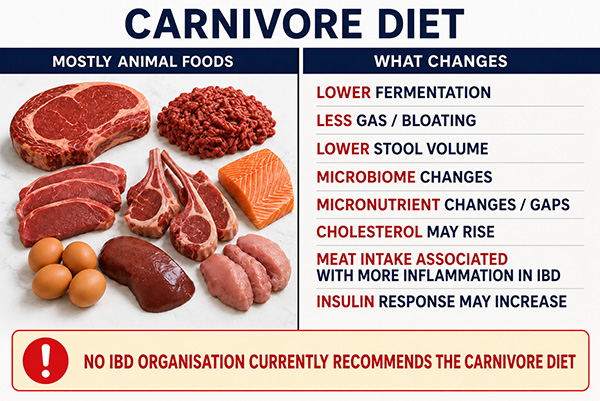
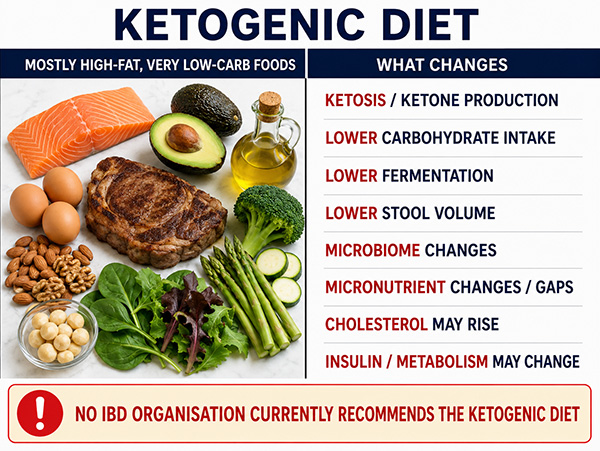
A ketogenic diet is designed to produce ketosis by keeping carbohydrate very low. A carnivore diet removes most or all plant foods. The Lion Diet is a more restrictive version of the carnivore diet, commonly centred on ruminant meat, salt and water.
What is the new trial comparing?
The recruiting study, NCT07524244, plans to enrol 160 adults in total across Crohn’s disease, ulcerative colitis and rheumatoid arthritis. It is not a study of 160 people with IBD alone.
After a three-week baseline period, participants are randomised to:
- a ketogenic diet;
- a carnivore or Lion Diet; or
- a wait-list control that continues usual diet.
During the first 12 weeks, the diet groups receive dietary guidance and the wait-list group provides the main comparison. After 12 weeks, wait-list participants are randomised to one of the diets. Participants are followed through a second 12-week phase.
The study will assess quality of life and disease-related symptoms. It will also collect objective measures including faecal calprotectin in participants with IBD, blood inflammatory markers, ketones, glucose, body composition, nutritional measurements and blood lipids.
The registry estimates that final data collection will be completed in September 2027. Results and a peer-reviewed publication may come later, but no publication date is available.
What will the results need to show?
Feeling better matters, but IBD symptoms and bowel inflammation do not always move together. A diet could reduce bloating or stool frequency without controlling Crohn’s disease or ulcerative colitis.
I will want to see how many participants complete each diet and how all randomised participants fare, including those who stop early. For the IBD group, the key objective result is whether faecal calprotectin falls. Results should also be reported separately for Crohn’s disease and ulcerative colitis, with medication changes clearly described.
Safety and practicality matter too. The study should tell us what happens to cholesterol, weight and nutritional markers, and whether people can sustain the diets.
There is an important design limitation. The first comparison is against a usual-diet wait-list, not against another supported dietary programme. Differences in coaching, expectation, weight loss and removal of ultra-processed foods may therefore contribute to any apparent benefit.
Is the carnivore diet currently recommended for IBD?
No major IBD guideline currently recommends a carnivore diet as an established treatment for Crohn’s disease or ulcerative colitis.
The ECCO consensus on dietary management of IBD supports specific nutritional approaches in defined settings, including exclusive enteral nutrition and the Crohn’s Disease Exclusion Diet for selected people with Crohn’s disease. It does not recommend a carnivore diet as IBD therapy.
The Crohn’s & Colitis Foundation also notes that restrictive diets can cause weight loss or malnutrition. Anyone considering a highly restrictive diet should discuss it with their IBD team and an IBD dietitian. An improvement in symptoms is not a safe reason to stop effective IBD medication without objective monitoring and clinical advice.
My current view
I do not currently recommend carnivore or ketogenic diets as treatments for Crohn’s disease or ulcerative colitis. I would neither dismiss the ten cases nor treat them as proof. They describe some striking experiences, but their selection tells us nothing about how often the diets work.
For limited periods, particularly during a flare, I sometimes use selected principles that overlap with parts of these diets. Reducing fibre or residue can lower stool volume, and reducing particular fermentable carbohydrates may ease bloating for some people. That is a short-term, individualised symptom strategy. It is not the same as prescribing a carnivore or ketogenic diet, and it does not by itself show that bowel inflammation is controlled.
The randomised study asks the more useful questions: how many people improve, whether bowel inflammation falls and what the nutritional and metabolic costs may be. I will reserve judgement on both diets until those results are available.
For more Crohn’s and Colitis updates from Dr Pranab, you can choose Gut Health Dubai as a Preferred Source on Google.
Frequently asked questions
Can a carnivore diet help Crohn’s disease?
We do not yet know how often it helps or whether it reliably controls bowel inflammation. A 2024 case series described four selected people with Crohn’s disease who had already improved, but it was not a treatment trial. A randomised study is now recruiting.
Can a carnivore diet help ulcerative colitis?
The current evidence is too weak to recommend it as a treatment. Six selected people with ulcerative colitis were included in the 2024 case series. The new trial should provide more useful prospective evidence.
What is the difference between keto and carnivore?
A ketogenic diet is designed to produce ketosis by keeping carbohydrate very low. It can include plant foods. A carnivore diet removes most or all plant foods and is based predominantly on animal foods.
Is the carnivore diet recommended for IBD?
No. Major IBD guidance does not currently recommend it as an established treatment. Restrictive diets can also affect nutrition, weight and cholesterol.
When will the new carnivore IBD trial report?
ClinicalTrials.gov estimates final data collection in September 2027. Results may be posted later, and the date of a full peer-reviewed publication is not yet known.
Educational note
This page is for general education and does not replace advice from your own gastroenterologist or IBD dietitian. Do not stop or change prescribed IBD treatment on the basis of symptom improvement alone.
Recommended related reading
Starting with practical IBD diet questions
- Coffee and bread in Crohn’s disease and ulcerative colitis
- What can I eat if I have Crohn’s disease or ulcerative colitis?
- Can a whole-food diet reduce Crohn’s inflammation?
- Elemental and enteral nutrition in Crohn’s disease
- Plant-based diet and Crohn’s disease: research update
Food type and processing
- Red meat, Crohn’s disease and ulcerative colitis
- Bread, ultra-processed grains and IBD
- Ultra-processed foods and the gut microbiome
Diet and the microbiome
- How the gut microbiome influences Crohn’s disease and ulcerative colitis
- How diet and gut bacteria interact in IBD
- The “oxygen trap”, diet and microbiome disruption in IBD
- Could the gut microbiome contribute to Crohn’s disease flares?
- What Akkermansia teaches us about fibre and microbiome context
Checking whether inflammation is actually improving
- Why can calprotectin be high when CRP is normal?
- Granzyme A: a possible next-generation stool marker for IBD
- Diet, calprotectin and flare prediction in Crohn’s disease and ulcerative colitis
- Can smartwatches, AI and calprotectin help predict IBD flares?
- Browse my latest Crohn’s disease and ulcerative colitis research VLOGs
Would you like to discuss this further?
If you would like further advice or wish to make an appointment, please use the form below. A member of our administrative team will contact you.