
By Dr Pranab Gyawali, Consultant Gastroenterologist
Introduction
One of the most frustrating parts of ulcerative colitis treatment is waiting to find out whether a biologic is actually going to work.
A patient may start vedolizumab, also known as Entyvio, go through the induction phase, continue treatment, and still be left wondering:
“Is this the right treatment for me?”
This is why research into early prediction matters.
In this VLOG, I discuss a recent study looking at whether changes in a blood marker called serum αvβ6 antibodies during the first six weeks of vedolizumab treatment may help predict longer term success in ulcerative colitis.
You can read the study summary here: Monitoring serum αvβ6 antibodies during induction vedolizumab therapy .
What is this VLOG about?
This VLOG is about a simple but important question:
Can we tell early whether vedolizumab is likely to work?
Vedolizumab is an integrin-targeting biologic used in ulcerative colitis and Crohn’s disease. It works mainly in the gut by reducing inflammatory immune cell movement into the bowel.
But not every patient responds.
The future of inflammatory bowel disease care is not simply choosing one biologic after another and waiting months to see what happens.
The future is trying to understand the pathway driving inflammation in that individual patient, and then asking whether the treatment is affecting that pathway early enough.
The brick wall analogy
In the video, I use a simple analogy.
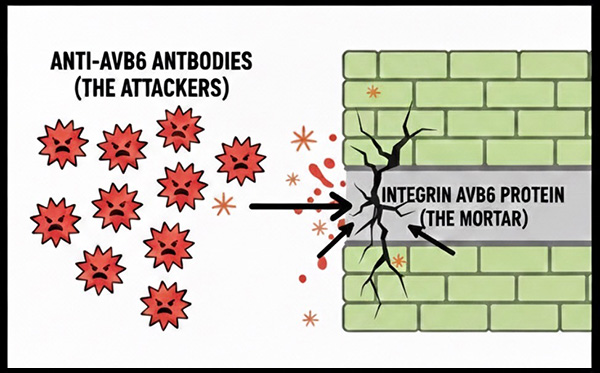
Think of the lining of the colon as a brick wall.
The cells are the bricks.
The proteins that help hold the lining together are like the mortar.
One of the proteins involved in this gut barrier system is called αvβ6 integrin.
In many patients with ulcerative colitis, antibodies against this αvβ6 system may be found in the blood. These antibodies may reflect immune activity linked to the gut lining and barrier damage.
When the wall is weakened, inflammation can break through more easily.
This is why the study is interesting. Vedolizumab is an integrin-targeting drug, so if integrin-related biology is important in a particular patient, vedolizumab may be more likely to help.
What did the research find?
The study measured serum αvβ6 antibody titres before vedolizumab treatment and again at week 6.
In ulcerative colitis patients, researchers found that a fall of more than 30% in αvβ6 antibody titres between week 0 and week 6 was strongly associated with sustained clinical remission at one year.
Put simply, if the antibody level fell early, the patient was much more likely to do well later.
The study reported that this early fall was associated with more than a fivefold higher chance of sustained remission at week 52.
This does not mean the test is ready for routine use in clinic.
But it does show the direction modern ulcerative colitis care is moving in: earlier biological signals, better treatment selection, and less trial and error.
Why does this matter for patients?
Symptoms alone can be misleading in ulcerative colitis.
Some patients feel better but still have active inflammation.
Others feel unwell because of bowel sensitivity, infection, IBS overlap, medication effects, or other factors rather than active colitis alone.
That is why doctors use objective markers such as stool calprotectin, blood tests, colonoscopy, and sometimes imaging to assess whether treatment is truly working.
This research adds another possible layer: pathway-specific prediction.
Instead of only asking whether symptoms have improved, we may increasingly ask:
“Is this treatment affecting the biology that is actually driving the inflammation?”
Is αvβ6 antibody testing available routinely?
Not yet.
This is not currently a routine blood test that most patients can request in standard clinical practice.
It should not be used by itself to start, stop, or change treatment.
However, it is important research because it shows where precision medicine in ulcerative colitis is heading.
- Earlier prediction of treatment response
- Less time lost on ineffective treatment
- Better matching of biologics to disease biology
- More personalised ulcerative colitis care
What should patients take away?
If you are taking vedolizumab, or if your doctor is considering vedolizumab for ulcerative colitis, this study does not mean that one experimental blood marker should decide your treatment plan.
But it does support a bigger shift in IBD care.
The key question is not only:
“Which drug should I try next?”
The better question is:
“What is driving my inflammation, and how early can we tell whether this treatment is working?”
That is the future of precision IBD care.
For now, treatment decisions should still be made using the full clinical picture, including symptoms, stool calprotectin, blood tests, endoscopy findings, previous treatment history, and specialist judgement.
Quick answers for patients
Can Entyvio response be predicted early?
Research suggests that early biological changes during vedolizumab induction may help predict longer term success in ulcerative colitis. In one study, a more than 30% fall in serum αvβ6 antibody titres by week 6 was linked with sustained remission at one year.
What is vedolizumab?
Vedolizumab, also known as Entyvio, is a gut-selective biologic used to treat ulcerative colitis and Crohn’s disease. It targets integrin-related immune cell movement into the bowel.
What are αvβ6 antibodies?
αvβ6 antibodies are antibodies linked to a gut barrier protein system. In ulcerative colitis, these antibodies may reflect immune activity affecting the bowel lining.
Should patients ask for this test now?
Not routinely. This testing is still mainly research based and is not part of standard ulcerative colitis care in most clinics.
What does this mean for precision IBD treatment?
It suggests that future ulcerative colitis treatment may become more personalised, using early biological signals to decide whether a drug is likely to work for that individual patient.
Recommended IBD VLOGs & Guides
Related Resources
- How severe will my Crohn’s or UC be?
- The new miR-124 treatment pathway
- AI in Crohn’s and Ulcerative Colitis: Can Machine Learning Predict IBD Treatment Response?
- Infliximab or vedolizumab for ulcerative colitis?
- Vedolizumab in Crohn’s Disease: Why Timing May Change Results
IBD Essentials
- Microbiome-Based IBD Diagnosis – New Testing Approach for Crohn’s & UC
- Protect Your Gut: 3 Foods to Avoid in Crohn’s & Colitis
- Crohn’s & Colitis in Dubai: Why You Shouldn’t Stay on Steroids
Treatments & Biologics
- Learn about Biologicals used in UC and Crohn’s in Dubai
- Rinvoq – How It Works for Crohn’s and Ulcerative Colitis
- Tremfya (Guselkumab) Explained
- BPC-157 for Crohn’s & UC — A Dubai Gastroenterologist’s Honest Opinion
Gut Barrier & Microbiome
- Leaky Gut in Crohn’s & UC: What It Really Means
- SIBO in Crohn’s & UC — The Overlooked Gut Issue
- IBD Breakthrough: How Gut Bacteria Unlock Natural Anti-Inflammatories
IBD-Related Deficiencies
Investigations & Procedures
- Hydrogen & Methane Breath Test (SIBO)
- Capsule Endoscopy
- Gastroscopy
- Colonoscopy
- CT Abdomen / CT Enterography
- MRI Abdomen / MR Enterography
If you wish to discuss this further or would like to make an appointment, please use the booking form on this page. Expect a response within 12 business hours.