
New genetic research in Crohn’s disease and ulcerative colitis, explained by Dr Pranab Gyawali, UK-trained consultant gastroenterologist.
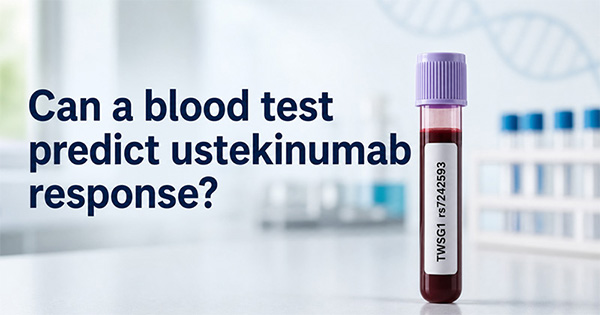
Can a blood test predict whether ustekinumab will work?
Not yet in routine clinical care.
A 2026 study found that patients with a particular variation in a gene called TWSG1 were more likely to be in remission after three months and 12 months of ustekinumab treatment.
The test can be done from a blood sample. I now have access to it through a specialist laboratory in Dubai. The important limitation is that it has not yet been validated for choosing who should receive ustekinumab.
If you are about to start ustekinumab, or you are already taking it and wondering whether it is the right treatment for you, this is probably the question you really want answered: is it likely to work for me?
Until now, we have not had a blood test that helps answer that question. We still do not have a definitive one, but this new study takes us a little closer.
I made this VLOG because the finding is practical. This is a blood test, and I have confirmed that I can access it through a specialist laboratory here in Dubai. I think it is worth using thoughtfully while we wait for stronger evidence about exactly how it should guide treatment.
What is ustekinumab?
Ustekinumab is a biologic used for moderate-to-severe Crohn’s disease and ulcerative colitis.
It targets the shared p40 subunit of two immune signalling proteins, IL-12 and IL-23. Treatment for IBD usually starts with an intravenous induction dose, followed by maintenance injections under the skin. Protocols, intervals and available brands vary between countries.
How does ustekinumab work in Crohn’s disease and ulcerative colitis?
Ustekinumab blocks two immune signalling pathways that can help maintain inflammation in the bowel. Reducing those signals can allow symptoms to settle and the bowel to heal.
Two people can have the same diagnosis but different dominant inflammatory biology. This is one reason one biologic may work extremely well for one patient and poorly for another.
Can a genetic blood test predict whether ustekinumab will work?
There is currently no routinely validated genetic blood test that can reliably tell an individual patient whether ustekinumab will work.
The new study supports an earlier signal seen in ustekinumab trials. It suggests that one variation in the TWSG1 gene may be linked to a better chance of remission. It is a useful clue, but not a pass or fail result for ustekinumab.
Which genetic variant did the study examine?
The test looks for a variation called TWSG1 rs7242593. It can be checked from an ordinary blood sample and sent to a laboratory that performs genetic testing.
Most patients in the study had the usual C/C result. Seventeen had the C/T variation linked to a better response. The T/T result was not seen. This does not mean that only these 17 patients could benefit, and everyone in the study had the TWSG1 gene.
What did the ustekinumab genetic study find?
The researchers studied 125 people with IBD receiving ustekinumab. The 17 people with the C/T variant were more likely than the 108 people with the C/C genotype to be in clinical remission at three months and 12 months while receiving standard-dose ustekinumab.
The result looks encouraging, but only 17 patients carried the variant. That is a small number. The study also measured clinical remission rather than confirming bowel healing by endoscopy. Patients without the variant could still respond.
Does a negative genetic result mean ustekinumab will not work?
No. Patients without the variant also achieved remission on ustekinumab.
If future studies confirm the finding, the variant may prove more useful as an enrichment marker, which is a clue that response is more likely, than as an exclusion marker. Ustekinumab should not be withheld solely because the variant is absent.
Could the genetic test help decide whether to increase the dose?
The study found that patients with the C/C genotype who had not reached remission did not appear to be rescued by higher-dose treatment. This was an observational finding. It does not prove that dose escalation is ineffective in every non-carrier.
The marker may eventually help identify patients in whom continuing to escalate ustekinumab is less likely to be worthwhile, but this requires prospective validation. For now, dose decisions still require the usual assessment of inflammation, drug exposure, disease complications and other treatment options.
What blood tests are normally done before starting ustekinumab?
Routine pretreatment screening is mainly about safety and infection risk. Depending on the person and local protocol, it may include:
- full blood count;
- liver and kidney function;
- inflammatory markers such as CRP;
- tuberculosis screening;
- hepatitis B and C testing;
- HIV testing where appropriate;
- vaccination review; and
- chest imaging where required.
These routine tests are performed primarily to assess safety and infection risk. They do not currently predict whether ustekinumab will successfully control an individual patient’s IBD. Exact testing varies by country, medical history and local protocol.
How long does ustekinumab take to work?
Some patients notice improvement within several weeks. Others need longer through the induction and early maintenance period. The appropriate assessment point depends on disease severity, steroid use, complications and what is happening objectively.
Symptoms are only part of the assessment. An IBD team may also review CRP, faecal calprotectin, steroid requirement, weight and nutrition, and endoscopy or imaging where appropriate.
What happens if ustekinumab is not working?
The first step is to establish whether the symptoms come from active inflammation. Strictures, infection, irritable bowel symptoms, bile acid diarrhoea, altered bowel function and other complications can produce similar symptoms.
When inflammation remains active, the IBD team may consider whether enough time has been allowed, objective inflammation results, drug exposure or trough-level testing in selected situations, a shorter dosing interval, another biologic or advanced therapy, or whether surgery or another intervention is needed. TWSG1 testing cannot yet make that decision.
Is ustekinumab used for both Crohn’s disease and ulcerative colitis?
Yes. Ustekinumab is used in moderate-to-severe Crohn’s disease and ulcerative colitis, although individual eligibility, reimbursement and available brands vary internationally.
Is TWSG1 testing available now?
Yes, the test itself is available. It is a blood test that looks for one particular genetic variation. A specialist laboratory that performs genetic testing should be able to advise whether it can offer it.
What the test cannot yet do is decide on its own whether someone should start, continue, increase or stop ustekinumab. It has not been validated for selecting treatment. The next important step is a prospective study asking whether using the result before treatment actually helps us choose ustekinumab more accurately.
How genetic testing is gradually changing biologic treatment
The UK-wide PANTS Consortium identified HLA-DQA1*05 as a marker associated with a greater risk of developing antibodies to infliximab and adalimumab. It does not tell us whether anti-TNF is the correct inflammatory pathway. It can help estimate whether a patient may form anti-drug antibodies more readily and inform how anti-TNF treatment is used.
I use HLA-DQA1*05 testing when clinically appropriate while considering infliximab, including decisions about monotherapy, combination treatment and monitoring. A group at Western University in Canada subsequently studied how HLA-DQA1*05 information could be applied prospectively to anti-TNF decisions. The same research programme has now independently investigated the earlier TWSG1 response signal in people receiving ustekinumab.
HLA-DQA1*05 shows how a genetic association can move gradually towards practical clinical use. TWSG1 is at a much earlier stage, but it may be beginning a similar journey.
Research sources
- Alkhalifa M et al. TWSG1 variation identifies a ustekinumab response phenotype in patients with inflammatory bowel disease (2026)
- Sazonovs A et al. HLA DQA1*05 and anti drug antibody development in the PANTS cohort
- Canadian prospective study of HLA DQA1*05 informed anti TNF treatment
- Feagan BG et al. Ustekinumab as induction and maintenance therapy for Crohn’s disease
- Ustekinumab prescribing information covering pretreatment TB evaluation and safety
My view on ustekinumab and this blood test
I have seen ustekinumab work extremely well for some patients, while others have an incomplete response or eventually need a different treatment. That uncertainty is exactly why I am interested in this test.
I will use the blood test selectively because it is available to me through a specialist laboratory in Dubai. I will not treat it as a yes or no answer. I will use it as one more piece of information when considering ustekinumab and reviewing how a patient is doing on treatment.
I expect that a prospective study will test the question that really matters: does using this result before treatment help us identify patients who are more likely to benefit from ustekinumab? Until then, the test is interesting and potentially useful, but it does not replace the rest of the treatment discussion.
For more Crohn’s disease and ulcerative colitis updates from Dr Pranab, you can choose Gut Health Dubai as a Preferred Source on Google.
Frequently asked questions
Can a blood test predict whether ustekinumab will work?
Not reliably in routine care. TWSG1 rs7242593 was associated with remission in one 2026 cohort, but prospective studies must show that testing improves treatment decisions.
Is the TWSG1 blood test available now?
Yes, the test itself can be done. Dr Gyawali has access to it through a specialist laboratory in Dubai, but it has not yet been validated for selecting ustekinumab treatment.
Does a negative TWSG1 result mean ustekinumab will fail?
No. People without the variant also achieved remission, so absence of the variant must not be treated as proof that ustekinumab will fail.
Can the ustekinumab dose be increased?
The dosing interval can be shortened in selected patients under specialist care. The TWSG1 study does not yet justify using genotype alone to decide whether escalation is worthwhile.
More from Dr Pranab about IBD treatment
Choosing and understanding biologics
Predicting and monitoring treatment response
Living safely with biologic treatment
This page is for education and does not provide personal medical advice. Do not start, stop, increase or change ustekinumab or any other IBD treatment based on genetic testing without discussing the full clinical picture with your own specialist.
Would you like to discuss ustekinumab or your IBD treatment?
If you wish to discuss this test, ustekinumab or another aspect of your Crohn’s disease or ulcerative colitis treatment, please use the appointment form below. A member of our team will contact you within 12 business hours.