
“I go to the toilet but still don’t feel empty.”
“I strain a lot but very little comes out.”
“It feels like the stool gets stuck.”
“I can spend a long time on the toilet and still feel blocked.”
“Laxatives help a bit, but something still feels wrong.”
Many people with these symptoms assume they simply have constipation.
Sometimes that is true. But in some patients, the main issue is not just slow bowel movement. The problem may involve how the pelvic floor muscles, rectum and anal sphincter coordinate during emptying.
This is called pelvic floor dysfunction. It may also be described as pelvic floor dyssynergia, obstructed defecation or incomplete evacuation.
At Gut Health Dubai, many patients are seen after trying fibre, laxatives, diet changes and repeated treatments, but still feeling blocked or incompletely emptied. The important point is that this is often not because the patient is doing something wrong. There may be a specific bowel emptying problem that needs to be identified.
What Is Pelvic Floor Dysfunction?
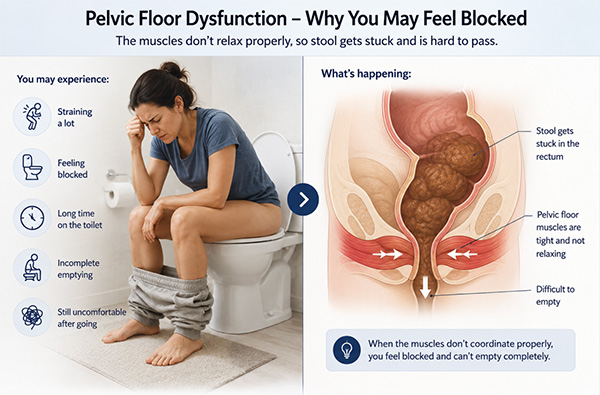
The pelvic floor is a group of muscles that supports the bowel, bladder and pelvic organs.
During a normal bowel movement, the pelvic floor muscles should relax, the anal sphincter should open and the rectum should help push stool out.
In pelvic floor dysfunction, this coordination may not happen properly.
The muscles may tighten when they should relax. The anal sphincter may not open properly. The rectum may not sense stool normally. The result is that stool can feel stuck, even when you are trying hard to empty.
This can lead to excessive straining, incomplete emptying, prolonged toilet time and repeated unsuccessful attempts to open the bowels.
Common Symptoms of Pelvic Floor Dysfunction
- Feeling blocked during bowel movements
- Stool feeling stuck
- Incomplete emptying
- Excessive straining
- Needing repeated trips to the toilet
- Spending a long time on the toilet
- Needing fingers or pressure to help evacuation
- Bloating or lower abdominal discomfort
- Constipation despite laxatives
- Feeling that bowel movements are never fully satisfying
Some patients are surprised to learn that these symptoms can happen even when colonoscopy results are normal.
Why Laxatives Alone Sometimes Do Not Solve the Problem
One of the biggest frustrations for patients is that standard constipation treatments may only partly help.
This is because constipation is not one single condition.
Some patients mainly have slow movement of stool through the colon. Some mainly have difficulty emptying from the rectum. Some have pelvic floor muscles that do not relax properly. Some have rectal sensation problems. Some have structural issues that affect evacuation.
In real life, more than one of these can happen together.
This is why simply increasing laxatives may not always be the answer. If the main issue is evacuation or pelvic floor coordination, the treatment may need to focus on how the bowel empties, not just how soft the stool is.
How Pelvic Floor Dysfunction Is Assessed
The first step is a careful history. The pattern of symptoms often gives important clues.
Advanced pelvic floor and constipation assessment is performed within a JCI-accredited hospital setting in Dubai, allowing access to specialised investigations including anorectal manometry, colonic transit studies and MRI defecography when appropriate.
Colonic Transit Studies
Sometimes the issue is that stool moves unusually slowly through the colon. A colonic transit study helps assess how quickly material travels through the bowel and whether slow transit constipation may be contributing to symptoms.
Anorectal Manometry and Rectal Sensation Testing
Anorectal manometry helps assess how the rectum and anal sphincter muscles function during bowel movements.
The test can help evaluate:
- pelvic floor coordination
- sphincter pressures
- rectal sensation
- difficulty relaxing during evacuation
Learn about anorectal manometry and advanced constipation testing
MRI Defecography
MRI defecography is a specialised MRI scan that helps visualise what physically happens during bowel emptying.
This can help assess:
- rectocele
- prolapse
- pelvic floor descent
- obstructed defecation
- structural emptying disorders
Why Identifying the Exact Pattern Matters
The right treatment depends on the underlying pattern.
If the bowel is moving slowly, treatment may involve motility-focused medication, secretagogues, prokinetic agents, osmotic laxatives or other medical therapies.
If the main problem is pelvic floor coordination, treatment may involve pelvic floor physiotherapy, biofeedback therapy and bowel habit retraining.
If there is a structural evacuation problem, MRI defecography may help guide whether further specialist input is needed.
The key is not to treat every patient with the same constipation plan.
Can Pelvic Floor Dysfunction Be Treated?
Yes. Many patients improve once the correct problem is recognised.
Treatment may include:
- Pelvic floor physiotherapy
- Biofeedback therapy
- Bowel habit retraining
- Optimising stool consistency
- Medication for associated constipation or IBS-C
- Treatment of slow transit constipation where present
- Further assessment of structural problems when needed
The aim is to help the pelvic floor muscles relax and coordinate at the right time, so bowel emptying becomes easier and more complete.
When Should You Consider Pelvic Floor Assessment?
You may benefit from specialist assessment if you have persistent constipation with any of the following:
- A blocked feeling during bowel movements
- Incomplete emptying
- Excessive straining
- Long toilet time
- Stool feeling stuck
- Repeated unsuccessful attempts to open the bowels
- Need for manual pressure or assistance
- Constipation with bloating and lower abdominal discomfort
- Normal colonoscopy but ongoing emptying symptoms
These symptoms do not always mean pelvic floor dysfunction, but they are strong reasons to consider a more detailed assessment.
Frequently Asked Questions About Pelvic Floor Dysfunction
Why do I still feel blocked after opening my bowels?
This may happen when stool does not fully empty from the rectum or when the pelvic floor muscles do not relax properly during evacuation. It can also occur with rectal sensation problems or obstructed defecation.
Can pelvic floor dysfunction cause constipation?
Yes. Pelvic floor dysfunction can make bowel emptying difficult even when stool is present and the patient is trying to pass it.
Can pelvic floor dysfunction happen with a normal colonoscopy?
Yes. Colonoscopy looks at the lining of the bowel. Pelvic floor dysfunction is a functional emptying problem, so colonoscopy may be normal even when symptoms are significant.
What is anorectal manometry?
Anorectal manometry is a test that measures anal sphincter pressure, rectal sensation and pelvic floor coordination during rest, squeezing and pushing.
What is MRI defecography?
MRI defecography is a specialised MRI scan that visualises how the pelvic floor and rectum move during attempted evacuation.
What is a colonic transit study?
A colonic transit study assesses how quickly stool moves through the colon and helps identify slow transit constipation.
Recommended Guides
Related Gut Health VLOGs
Related Gastroenterology Topics
Investigations and Procedures
If you wish to discuss this further or would like to make an appointment, please use the booking form on this page. Expect a response within 12 business hours.