
“It feels like something is blocking the stool from coming out.”
Some patients do not simply have constipation.
They may describe feeling blocked during bowel movements, incomplete emptying, stool feeling stuck, excessive straining, repeated attempts to open the bowels or a feeling that something is pushing down or bulging.
In these situations, the issue may not only be how slowly the bowel moves. The problem may be what physically happens during attempted bowel emptying.
MRI defecography is a specialised MRI scan that helps visualise the pelvic floor and rectum during evacuation. It can show whether there is a structural or mechanical reason why stool does not empty properly.
At Gut Health Dubai, MRI defecography is used as part of advanced constipation and pelvic floor assessment when symptoms suggest obstructed defecation, pelvic floor descent, rectocele, prolapse or complex evacuation difficulty.
What Is MRI Defecography?
MRI defecography is a dynamic pelvic floor MRI scan.
Unlike a standard MRI abdomen, which mainly takes still images, MRI defecography looks at how the rectum and pelvic floor move during attempted emptying.
It helps assess the mechanics of evacuation.
This can be useful when symptoms suggest that stool is not coming out properly because of a structural or movement-related pelvic floor problem.
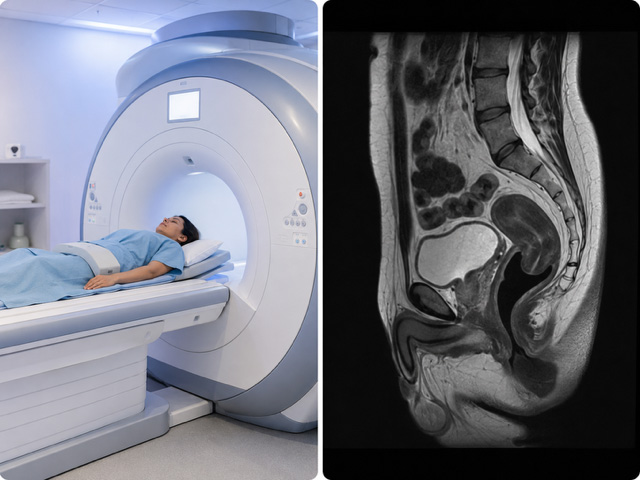
What Can MRI Defecography Show?
MRI defecography can help assess for:
These findings can be important because some patients have symptoms that cannot be fully explained by colonoscopy, blood tests or routine scans.
When Might MRI Defecography Be Useful?
MRI defecography may be considered when patients have:
- Incomplete emptying
- A feeling of blockage during bowel movements
- Excessive straining
- Stool feeling stuck
- A sense of bulging or pressure
- Suspected rectocele or prolapse
- Persistent constipation despite treatment
- Symptoms of obstructed defecation
- Evacuation problems despite normal colonoscopy
It is especially useful when the question is:
“What physically happens when I try to empty?”
How Is MRI Defecography Different From Anorectal Manometry?
This distinction is important.
Anorectal manometry measures function. It looks at anal sphincter pressure, rectal sensation, reflexes and pelvic floor coordination.
MRI defecography visualises movement and structure. It shows what happens to the rectum, pelvic floor and nearby organs during attempted evacuation.
Anorectal manometry helps answer:
Are the muscles and nerves coordinating properly?
MRI defecography helps answer:
Is something mechanically preventing proper emptying?
In some patients, both tests may be useful because function and structure can overlap.
How MRI Defecography Fits Into Advanced Constipation Assessment
Constipation is not one single condition.
Some patients have slow movement through the colon. Some have pelvic floor coordination problems. Some have structural or mechanical evacuation issues.
MRI defecography is particularly helpful when the concern is obstructed defecation or a structural pelvic floor problem.
Other tests may include:
Colonic transit study
To assess how slowly stool moves through the colon.
Anorectal manometry
To assess pressure, sensation and pelvic floor coordination.
Colonoscopy
To exclude structural bowel disease when appropriate.
The aim is to avoid treating every patient with the same constipation plan and instead identify the underlying pattern.
What Is the Test Like?
MRI defecography is performed in an MRI setting.
The test is designed to capture images of the pelvic floor and rectum while the patient performs specific manoeuvres, including attempted evacuation.
Patients can feel embarrassed about the idea of the test, but the purpose is medical and practical. It helps assess a problem that is often difficult to explain in words.
The scan does not involve surgery.
Your clinical team will explain the preparation and what to expect before the appointment.
Why This Test Can Change Management
MRI defecography can help clarify whether symptoms are linked to a mechanical emptying problem.
The results may help guide:
- Pelvic floor physiotherapy
- Biofeedback therapy
- Bowel habit retraining
- Medication choices for constipation
- Further pelvic floor assessment
- Referral for specialist pelvic floor or surgical opinion when appropriate
The test does not automatically mean surgery is needed. In many patients, it helps guide more targeted non-surgical treatment.
MRI Defecography in a JCI-Accredited Setting in Dubai
MRI defecography forms part of advanced constipation and pelvic floor assessment available through the clinic and hospital setting where Dr Pranab Gyawali practises in Dubai.
The centre is JCI-accredited, reflecting internationally recognised healthcare quality and safety standards.
This is helpful for patients with persistent constipation, incomplete emptying, obstructed defecation or suspected pelvic floor structural problems who need a more precise assessment.
Frequently Asked Questions About MRI Defecography
What is MRI defecography used for?
MRI defecography is used to assess how the rectum and pelvic floor move during attempted bowel emptying. It can help detect obstructed defecation, rectocele, prolapse and pelvic floor descent.
Is MRI defecography the same as a normal MRI abdomen?
No. A normal MRI abdomen mainly takes still images. MRI defecography is a dynamic pelvic floor scan that looks at evacuation mechanics.
Can MRI defecography help explain incomplete emptying?
Yes. MRI defecography may show whether there is a structural or mechanical reason why stool does not empty properly.
What is the difference between MRI defecography and anorectal manometry?
Anorectal manometry measures pressure, sensation and coordination. MRI defecography visualises the movement and structure of the pelvic floor and rectum during attempted evacuation.
Does MRI defecography mean I need surgery?
No. The test helps clarify the cause of symptoms. Many patients are managed with pelvic floor physiotherapy, biofeedback therapy, bowel habit retraining or medical treatment.
Can MRI defecography be useful if colonoscopy is normal?
Yes. Colonoscopy looks at the lining of the bowel. MRI defecography assesses pelvic floor movement and evacuation mechanics, which are different issues.
Recommended Guides
Related Gastroenterology Topics
Investigations and Procedures
If you wish to discuss this further or would like to make an appointment, please use the booking form on this page. Expect a response within 12 business hours.