
By Dr Pranab Gyawali, Consultant Gastroenterologist
Published and medically reviewed:
IBS assessment and treatment in Dubai
If you have recurring abdominal pain together with constipation, diarrhoea or a mixture of both, you may be wondering whether IBS is the explanation. You may already have been told that you have IBS but still be struggling with bloating, urgency, food related symptoms or treatment that has not worked as expected.
Dr Pranab Gyawali assesses and treats adults with suspected or previously diagnosed IBS in Dubai. He is a Consultant Gastroenterologist with more than 25 years of experience in London and Dubai and a particular interest in disorders of gut brain interaction, bowel function and gut health.
The first appointment is used to understand your symptom pattern, review previous tests and treatment, look for features that may suggest another condition and decide what should happen next. Not every patient needs a colonoscopy, SIBO breath test or microbiome test.
Assessment takes place in a JCI accredited clinical facility in Dubai.
Quick answers
Who should request an IBS assessment?
You can request an assessment if you have recurring abdominal pain with constipation, diarrhoea or a mixed bowel pattern. It may also be useful if you have already been diagnosed with IBS but symptoms remain troublesome, your bowel pattern has changed or your current treatment is not helping.
What happens at the first appointment?
Dr Pranab reviews the timing and pattern of your symptoms, bowel habit, food relationship, previous infections, medicines, stress and sleep where relevant. He also reviews previous tests and performs a clinical examination.
What should I bring?
Bring any previous blood, stool, scan, gastroscopy or colonoscopy reports that are available. A list of medicines and supplements is helpful. A brief record of your bowel pattern, pain and important food triggers may also help, but you do not need to complete a complicated diary.
Will I need tests?
Not necessarily. IBS can often be diagnosed from a characteristic symptom pattern, a clinical examination and a limited number of targeted tests. Further investigation is chosen according to the individual clinical picture.
Will I need a colonoscopy?
A colonoscopy is not routinely required to diagnose IBS. It may be recommended if there is a clinical concern.
How is IBS treated?
Treatment depends on whether constipation, diarrhoea, pain, bloating or urgency is the main problem. It may include bowel regulation, a structured food and fibre review, a limited low FODMAP trial, symptom directed medication and gut brain treatment where appropriate.
 WhatsApp the Admin Team
What happens during an IBS consultation?
IBS should not be diagnosed simply because a scan or colonoscopy was normal. The symptom pattern still matters.
Dr Pranab will ask about the relationship between abdominal pain and bowel movements, whether stools are hard or loose, whether there is urgency or incomplete emptying and how symptoms change after meals. Previous gastrointestinal infections, antibiotic exposure, travel, medicines, food restriction and stress may also be relevant.
The aim is to decide whether the pattern fits IBS, whether another condition needs to be excluded and which symptom should be treated first.
Could my symptoms be IBS?
IBS commonly causes recurrent abdominal pain together with a change in bowel habit. The bowel may be constipated, loose or alternate between the two.
- Bloating or abdominal distension
- Urgency
- A feeling of incomplete emptying
- Mucus in the stool
- Pain or symptoms that change after opening the bowels
- Symptoms that become worse after particular meals
Bloating, fatigue, nausea or food sensitivity alone do not prove that someone has IBS. The overall pattern and the absence of another explanation are important.
Which IBS bowel pattern do I have?
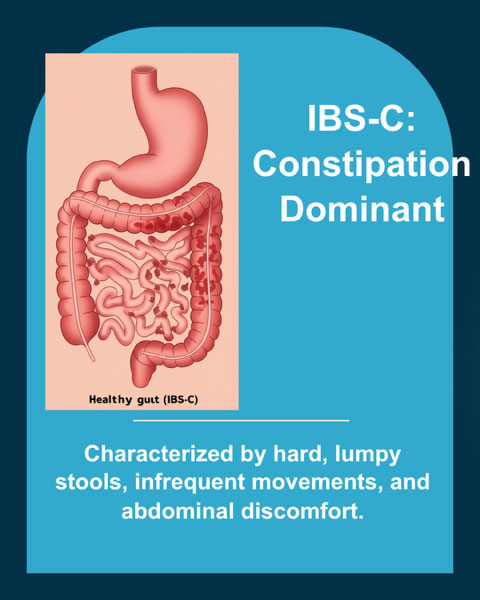
IBS with constipation
IBS C usually involves abdominal pain with hard or infrequent stools. Bloating and incomplete emptying may also occur. Some patients thought to have IBS C have slow bowel transit or a pelvic floor evacuation problem, particularly when standard treatment has repeatedly failed.
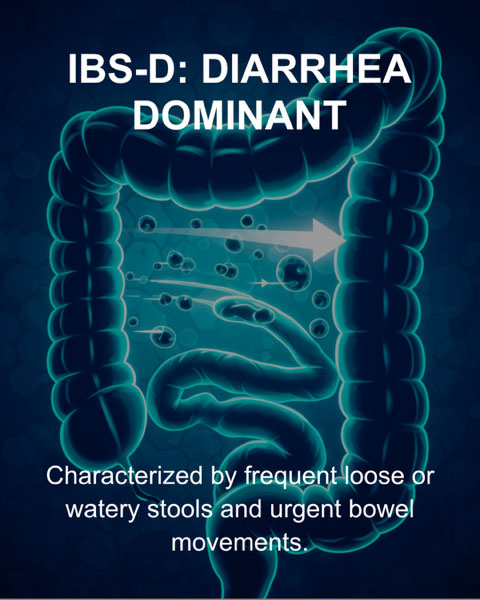
IBS with diarrhoea
IBS D usually involves abdominal pain with loose stools, urgency or bowel movements soon after eating. Coeliac disease, bowel inflammation, infection, medicine effects and bile acid diarrhoea are among the alternative explanations that may need consideration in selected patients.
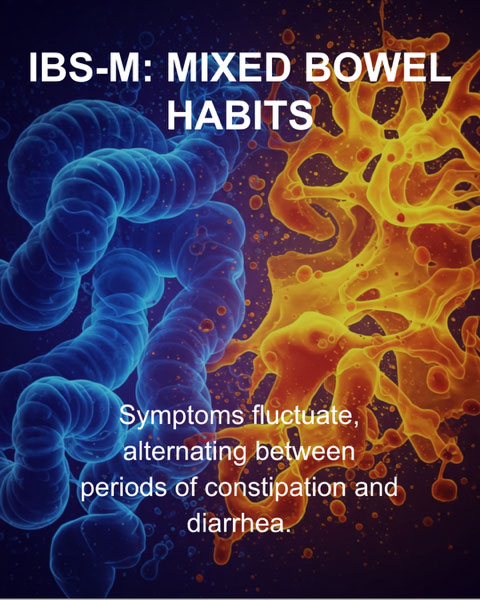
IBS with mixed bowel habit
IBS M involves periods of constipation and periods of loose stool. Treatment needs to follow the current pattern rather than using the same medicine continuously regardless of how the bowel is behaving.
How is IBS diagnosed?
There is no single blood test, scan, stool test or endoscopy that confirms IBS.
Current gastroenterology guidance supports making a positive diagnosis when the symptom pattern fits IBS and there are no concerning features. This is different from ordering every available test and calling the condition IBS only when every result is normal.
Depending on the presentation, Dr Pranab may consider:
- Blood tests for anaemia, inflammation or coeliac disease
- A stool calprotectin test when bowel inflammation needs to be excluded
- Infection testing when the history suggests it
- Colonoscopy when there is a clinical reason for it
- Selected breath or bowel function tests when the symptom pattern points to a specific alternative explanation
Tests are selected to answer a clinical question. They are not a standard package that every person with IBS needs.
Is SIBO testing always needed in IBS?
No. IBS and small intestinal bacterial overgrowth can cause overlapping symptoms, but they are not the same condition.
A hydrogen and methane breath test may be useful when the history makes SIBO a reasonable possibility. It should not be treated as the single best test for IBS.
Is microbiome testing always needed in IBS?
No. A microbiome test is not required to diagnose IBS and does not identify the cause of every IBS symptom.
It may provide additional information in selected patients when there is a clear reason for testing and the result will be interpreted with the medical history, symptoms and diet. It does not replace blood tests, stool inflammation markers, endoscopy or other investigations when these are needed.
How is IBS treated?
There is no single treatment for every patient. Dr Pranab chooses treatment according to the bowel pattern, the most disruptive symptom, previous treatment and any alternative explanation identified during assessment.
Bowel pattern and urgency
Treatment may focus first on stool consistency and bowel frequency. Medication is chosen according to whether constipation, diarrhoea or urgency is the dominant problem.
Food and fibre
The first step is usually to understand the existing diet. Soluble fibre may help some patients, while increasing coarse fibre indiscriminately can worsen bloating.
Low FODMAP diet
A limited low FODMAP trial may help selected people. Foods should then be reintroduced systematically rather than maintaining a permanently restrictive diet.
Abdominal pain
Selected medicines can reduce bowel spasm or alter the way pain signals are processed. The choice depends on symptoms, other conditions and possible side effects.
The gut brain interaction
IBS is a disorder of gut brain interaction. This does not mean symptoms are imagined. Stress, sleep and nervous system signalling can alter bowel movement and pain sensitivity.
Reviewing progress
Follow up is used to assess which symptoms improved, which did not and whether the diagnosis or treatment plan needs to be reconsidered.
Gut directed psychological treatment, including cognitive behavioural approaches or gut directed hypnotherapy, may help selected patients when symptoms remain difficult despite dietary and medical treatment.
When should IBS symptoms be reassessed?
Symptoms should not automatically be attributed to IBS if you develop blood in the stool, unexplained weight loss, iron deficiency or anaemia, fever, persistent night symptoms, a significant new change in bowel habit or another clinical concern.
New or changing symptoms deserve medical review even if IBS was diagnosed previously.
Frequently asked questions
Can IBS be cured permanently?
There is no guaranteed permanent cure. Symptoms can improve substantially when the dominant bowel pattern and contributing factors are identified. Treatment may need to change if the pattern changes over time.
Is IBS dangerous or does it lead to bowel cancer?
IBS does not damage the bowel or turn into bowel cancer. However, a previous IBS diagnosis should not be used to dismiss an important change in symptoms.
Does stress cause IBS?
Stress is not the only cause of IBS. It can alter bowel movement, urgency and pain sensitivity through the gut brain interaction. Addressing stress may be one part of treatment, but it should not replace medical assessment.
Are probiotics helpful for IBS?
Some people report improvement with a particular probiotic, while others develop more gas or bloating. Products contain different organisms and doses, so they should not be assumed to help every IBS subtype.
Related care and gut health guides
Request an IBS assessment in Dubai
If recurring abdominal pain, constipation, diarrhoea, urgency or mixed bowel habits are affecting daily life, you can request an appointment using the form below or contact the Admin Team on WhatsApp.