
“Why do I still feel blocked even when I’m trying to open my bowels properly?”
Some patients with constipation are not simply dealing with slow bowel movement.
They may describe stool feeling stuck, excessive straining, incomplete emptying, repeated unsuccessful toilet trips or a blocked sensation despite laxatives.
In these situations, the issue may involve how the rectum, anal sphincter and pelvic floor muscles are functioning during evacuation.
Anorectal manometry is a specialised test that helps assess how these muscles and reflexes are working during bowel emptying.
At Gut Health Dubai, anorectal manometry is used as part of advanced constipation and pelvic floor assessment for patients with difficult or unexplained evacuation symptoms.
What Is Anorectal Manometry?
Anorectal manometry is a functional test that measures anal sphincter pressures, pelvic floor muscle coordination, rectal sensation, rectal reflexes and evacuation mechanics.
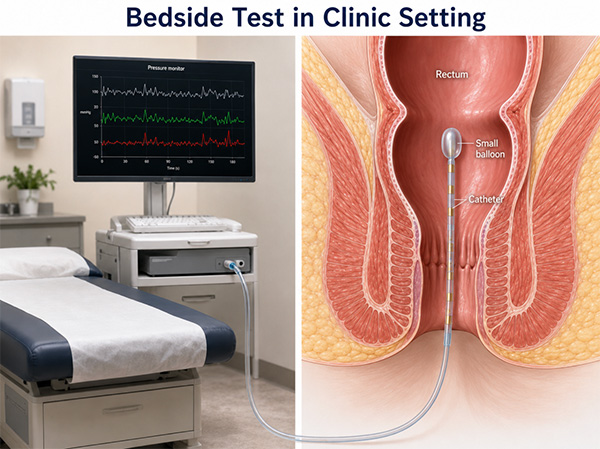
A small flexible catheter is gently placed into the rectum to assess how the muscles behave during resting, squeezing, pushing and attempted evacuation.
In some cases, a small balloon at the catheter tip is also used as part of the assessment, which helps with rectal sensation testing and balloon expulsion assessment.
The test helps show whether the muscles are coordinating properly during bowel emptying.
Why Might Someone Need Anorectal Manometry?
- Constipation despite treatment
- Incomplete emptying
- Excessive straining
- Obstructed defecation
- Stool feeling stuck
- Suspected pelvic floor dysfunction
- Repeated unsuccessful bowel movements
- Chronic constipation not responding to laxatives
- Evacuation difficulty despite normal colonoscopy
Some patients have relatively normal stool frequency but still feel that evacuation is incomplete or difficult. Others may have a combination of slow bowel movement and pelvic floor dysfunction together.
The Difference Between Slow Constipation and Evacuation Problems
One of the important reasons for anorectal manometry is that not all constipation behaves in the same way.
In some patients, the bowel itself moves too slowly.
In others, the main problem is difficulty emptying from the rectum.
And in some people, both problems coexist.
This distinction matters because treatment may differ substantially depending on the underlying pattern.
What Does Anorectal Manometry Assess?
Anal Sphincter Pressure
Whether the anal muscles are too tight, too weak or not coordinating normally.
Pelvic Floor Coordination
Whether the pelvic floor muscles relax appropriately during attempted evacuation.
Rectal Sensation
Whether the rectum senses stool normally or whether sensation is reduced or altered.
Rectal Reflexes
Important reflex pathways involved in bowel emptying.
Balloon Expulsion Assessment
In some patients, balloon testing helps assess evacuation mechanics and can complement the physiology assessment.
What Is the Test Like?
Many patients are understandably anxious before the test because they are unfamiliar with it.
In reality, anorectal manometry is usually relatively quick, minimally invasive and well tolerated.
It is commonly performed as a bedside test in a clinic setting and does not involve sedation or surgery.
Most patients are able to return home shortly afterwards.
How Anorectal Manometry Fits Into Advanced Constipation Assessment
Anorectal manometry is often used alongside other specialised investigations depending on symptoms.
Colonic transit studies
To assess how quickly stool moves through the colon.
MRI defecography
To assess structural or mechanical evacuation problems such as prolapse, rectocele or pelvic floor descent.
Colonoscopy
To exclude structural bowel disease where appropriate.
Advanced anorectal physiology assessment is performed within a JCI-accredited hospital setting in Dubai, allowing access to integrated constipation and pelvic floor investigations when appropriate.
Can the Results Change Treatment?
Yes.
The findings may help guide pelvic floor physiotherapy, biofeedback therapy, bowel habit retraining, constipation medication choices, management of evacuation disorders and decisions regarding further pelvic floor assessment.
The aim is to identify why symptoms are happening rather than repeatedly escalating laxatives without understanding the underlying mechanism.
Frequently Asked Questions
Is anorectal manometry painful?
The test is usually well tolerated and does not involve surgery or sedation.
Does anorectal manometry help diagnose pelvic floor dysfunction?
Yes. It is commonly used to assess pelvic floor coordination and evacuation disorders.
Can anorectal manometry explain incomplete emptying?
In many patients, yes. The test may identify coordination or sensation problems affecting evacuation.
How long does anorectal manometry take?
The test is usually relatively quick and performed in a bedside clinic setting.
Can anorectal manometry be normal even when symptoms are significant?
Yes. Sometimes additional tests such as MRI defecography or colonic transit studies may also be needed depending on symptoms.
What is the difference between anorectal manometry and MRI defecography?
Anorectal manometry measures muscle pressures, sensation and coordination. MRI defecography visualises what physically happens during evacuation.
Recommended Guides
- Colonic transit study to assess slow bowel movement
- MRI defecography to assess structural emptying problems
- Constipation Treatment in Dubai
- Pelvic Floor Dysfunction and Incomplete Emptying
- Bloating Treatment in Dubai
- IBS Treatment in Dubai
- Diagnostic Tests for Gastrointestinal Disorders
Related Gut Health VLOGs
- Gut Health VLOG Archive
- Stress, the Gut-Brain Axis and Digestion
- Serotonin and Gut Health
- Sleep and Gut Health
- Ultra-Processed Foods and Gut Microbiome
Investigations and Procedures
If you wish to discuss this further or would like to make an appointment, please use the booking form on this page. Expect a response within 12 business hours.