
Written and medically reviewed by: Dr Pranab Gyawali, UK trained Consultant Gastroenterologist
Can worms treat Crohn's disease or ulcerative colitis?
Short answer: Live worms are not a proven treatment for Crohn's disease or ulcerative colitis.
A small hookworm study in ulcerative colitis was designed mainly to see whether a larger trial could be conducted. It did not show a significant benefit over placebo. Earlier pig whipworm research in Crohn's disease looked promising, but that benefit disappeared in a much larger placebo controlled trial. A later controlled study in active ulcerative colitis was also negative.
The treatment remains experimental. I would not recommend obtaining hookworms or pig whipworm eggs or trying to infect yourself outside properly regulated clinical research.
One of my patients with Crohn's disease sent me a video about hookworm therapy and asked what I thought. The study being discussed was actually in ulcerative colitis, but it led to a wider and genuinely interesting story: why researchers considered worms, what the human trials found, and whether the biology could still lead to a medicine.
Watch the VLOG
In this short video, I explain the difference between the human hookworm and pig whipworm studies. This also explains why an intriguing immune theory has not translated into an effective live worm treatment.
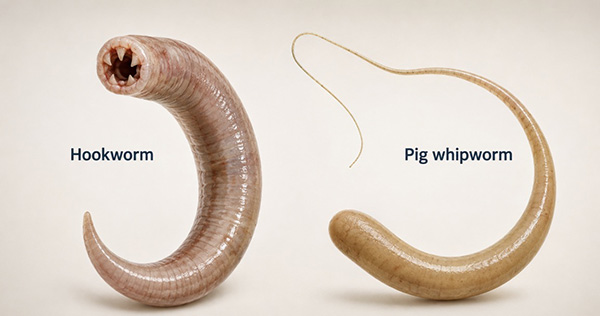
What is hookworm therapy, and is it the same as pig whipworm therapy?
No. These are different organisms and different experimental approaches.
The ulcerative colitis study used 30 larvae of the human hookworm Necator americanus. The larvae were placed on a dressing against the forearm. They penetrated the skin, travelled through the circulation to the lungs, were swallowed and reached the small intestine, where adult hookworms live.
The Crohn's disease studies used eggs from the pig whipworm Trichuris suis. Participants swallowed the eggs in a liquid. “Helminth therapy” is the broader term for deliberate exposure to parasitic worms or products derived from them.
Neither approach is an approved or established treatment for inflammatory bowel disease.
What happened in the ulcerative colitis hookworm study?
The 2024 hookworm pilot study included 20 people whose ulcerative colitis was already in remission. They were taking only 5 ASA at enrolment and were randomised to receive 30 hookworm larvae or placebo. After 12 weeks, they stopped 5 ASA and were monitored for up to a year.
At week 52, four of the ten people given hookworms remained in remission. Five of the ten given placebo remained in remission. The difference was not statistically significant.
Almost everyone in the hookworm group developed a productive infection, and everyone in that group developed eosinophilia, a rise in a type of white blood cell often seen with parasitic infection. Reported adverse effects were generally mild, including skin irritation and gastrointestinal symptoms.
The correct interpretation is narrow: the investigators showed that a larger controlled study could technically be carried out. They did not demonstrate that hookworms maintained ulcerative colitis remission.
What happened when pig whipworm was tested in Crohn's disease?
An early 2005 Crohn's disease study included 29 people with active disease. They swallowed 2,500 pig whipworm eggs every three weeks for 24 weeks. At the end, about 79% met the study’s definition of response and 72% met its definition of clinical remission.
Those results attracted attention, but there was no placebo group. The study could not show how much of the improvement came from the worms themselves.
A larger randomised, double blind trial later studied 252 adults with active Crohn's disease. It compared three doses of pig whipworm eggs with placebo. Remission rates were 38.5%, 35.2% and 47.2% across the three worm-dose groups, compared with 42.9% on placebo. There was no convincing dose response relationship, and recruitment was stopped for futility.
The promising signal from the small uncontrolled study had disappeared when tested against placebo.
What did the later ulcerative colitis whipworm trial find?
The 2024 PROCTO trial studied 119 people with moderately active ulcerative colitis. Participants received 7,500 pig whipworm eggs every two weeks for 24 weeks or placebo.
Clinical remission occurred in 30% of the whipworm group and 34% of the placebo group. There was no benefit in the main clinical or endoscopic outcomes.
| Study | Disease | Worm treatment | Main finding |
|---|---|---|---|
| 2005 | Crohn's disease | Pig whipworm eggs | Promising uncontrolled result |
| 2017 | Crohn's disease | Pig whipworm eggs | No benefit over placebo |
| 2024 | UC in remission | Human hookworm larvae | Feasible pilot; no efficacy signal |
| 2024 PROCTO | Active UC | Pig whipworm eggs | No benefit over placebo |
Why did researchers consider worms in the first place?
Parasitic worms can survive inside a host for years partly because they alter immune responses. Laboratory and animal research suggests that they may influence regulatory immune activity, mucus, the bowel barrier and the microbiome.
The idea also fitted with the “hygiene hypothesis”, now often described as the old friends or microbial deprivation hypothesis. Humans once had much broader contact with animals, soil organisms, environmental microbes and parasites. Changes in those exposures may affect how the immune system develops.
The mechanisms remain biologically plausible, but they are supported mainly by laboratory and animal research. They have not produced reliable clinical benefit from live worm treatment in human IBD trials.
Could worms still lead to a future IBD medicine?
Possibly, but the likely future is not prescribing live parasites.
Worms release proteins, sugars, fats, metabolites and tiny biological packages that can interact with the host immune system. Researchers may eventually identify a useful signal, manufacture it in a consistent form and deliver it to the bowel at a known dose.
Any such treatment would need proper testing against objective outcomes such as endoscopic healing, histology, calprotectin and durable steroid free remission. This work remains largely preclinical or at an early translational stage.
Can I buy hookworms or pig whipworm eggs and try this myself?
I would not advise it. Products obtained outside regulated research may vary in species, dose, viability, purity and handling. Intentional infection also introduces uncertainty for anyone taking steroids, biologics or other immune modifying treatment.
Do not stop 5 ASA, a biologic or another prescribed IBD treatment to try worm therapy. If an unconventional treatment interests you, discuss the evidence and the risks with your gastroenterologist first.
My clinical view
I would not recommend hookworm or pig whipworm therapy to a patient with Crohn's disease or ulcerative colitis outside a regulated clinical trial. The controlled human evidence has not shown reliable benefit, and deliberate infection adds avoidable uncertainty.
I do not dismiss the immunology. Worms have evolved sophisticated ways of interacting with the immune system. The worm itself has not proved to be the medicine, but the biological signals it produces may still help researchers design one.
Was this helpful? Prefer updates from this website in Google.
Important educational note
This article and video are for general education and do not provide individual medical advice. Live hookworm and pig whipworm therapy remain experimental and should not be attempted outside properly regulated clinical research. Do not stop or change prescribed Crohn's disease or ulcerative colitis treatment without discussing it with your gastroenterologist.
Recommended related reading
Understanding IBD and established treatment
- Inflammatory bowel disease
- Crohn's disease assessment and treatment
- Ulcerative colitis treatment and monitoring
- Biologic treatments for Crohn's disease and ulcerative colitis
Microbiome and experimental-treatment research
- Faecal microbiota transplant research in IBD
- The gut microbiome in Crohn's disease and ulcerative colitis
- Browse Crohn's disease and ulcerative colitis VLOGs
Discussing your IBD treatment
If you wish to discuss this further or would like to make an appointment, please use the booking form on this page. A member of our team will contact you within 12 business hours.